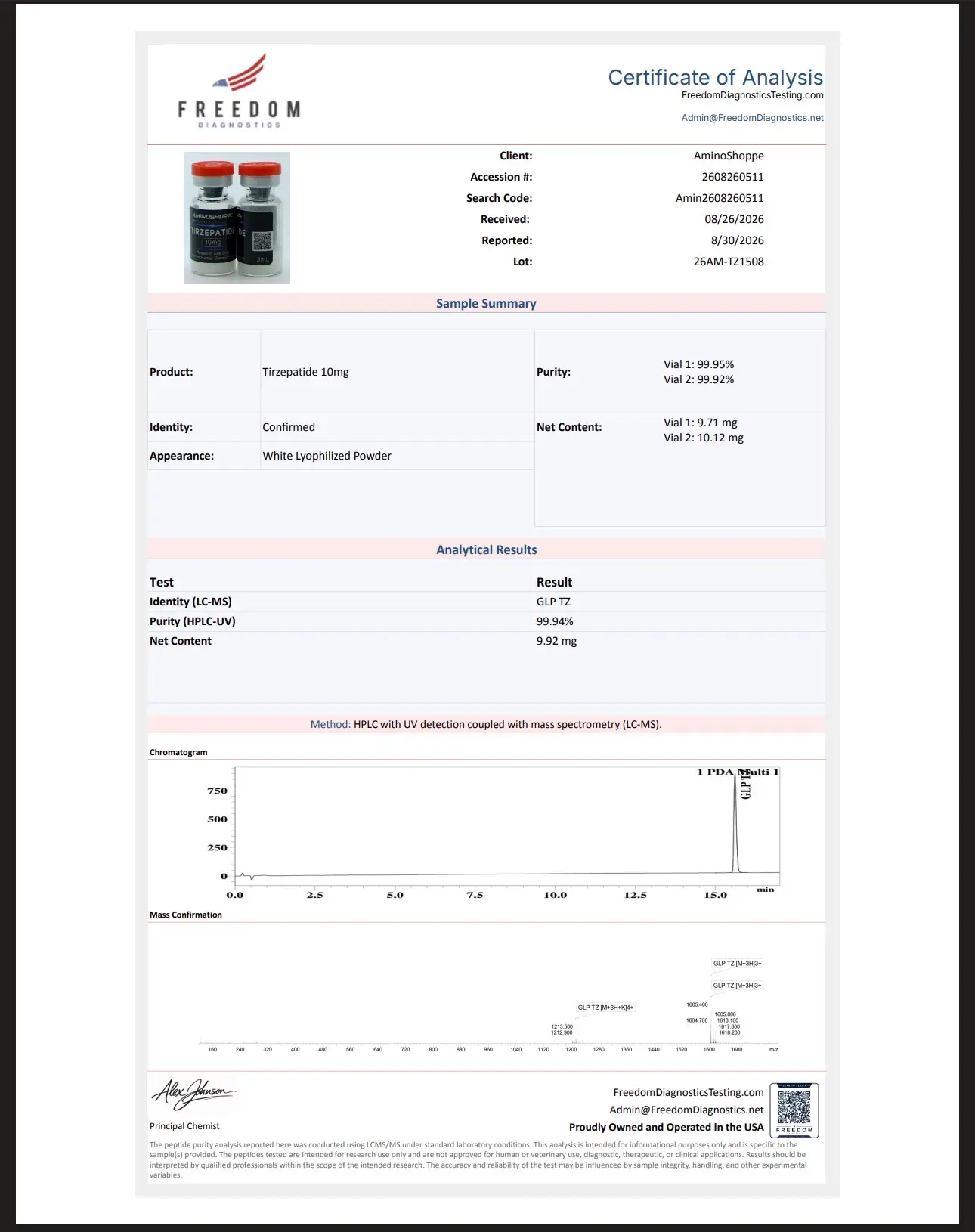
A certificate of analysis should let a research buyer connect a specific material to a specific test result. If you are learning how to check lab test certificates, start with that traceability requirement. A document that looks technical but cannot be matched to the item, lot, and laboratory that produced it does not provide meaningful quality verification.
For research-use-only materials, a certificate is one part of a disciplined procurement review. It can support decisions about product identity, reported purity, analytical method, and lot-level consistency. It does not change the intended-use restrictions of a material. Products designated for laboratory research only are not for human or animal consumption.
How to Check Lab Test Certificates for Traceability
Begin with the product identity. The certificate should identify the compound in a way that matches the product being purchased. Depending on the material, this may include the peptide sequence, compound name, molecular formula, molecular weight, salt form, or other identifying information. A broad label such as “research peptide” is not sufficient when the product listing specifies a defined compound.
Next, compare the lot or batch number on the certificate with the lot or batch number assigned to the product. This is the most practical control a buyer can apply. Testing performed on one production lot does not automatically validate every later lot. If the certificate has no lot identifier, or if the identifier cannot be connected to the material supplied, treat the document as general reference information rather than lot-specific evidence.
Dates also matter. Review the sample receipt date, test date, certificate issue date, and any retest or expiration date where applicable. A recent certificate is not inherently better than an older one if it applies to the exact lot being evaluated. Conversely, a current document for a different lot does not establish the quality of the material in question.
A credible document should identify the testing laboratory or analytical provider. Look for a laboratory name, report number, contact details, analyst or reviewer authorization, and a clear record of the work performed. A logo alone is not verification. The report should provide enough information for the laboratory and report to be distinguishable from a supplier-created summary.
Read the Analytical Method, Not Just the Purity Number
Many buyers go directly to the purity percentage. That number is useful, but it needs context. A reported purity of 99% means little without knowing which method produced the result and what the method is designed to measure.
For peptides and similar research compounds, high-performance liquid chromatography, often abbreviated HPLC, is commonly used to assess chromatographic purity. The certificate should state the method or reference it clearly. A chromatogram may show the principal peak and supporting peaks, allowing a technically informed buyer to assess whether the reported result is consistent with the visual data.
Mass spectrometry, including LC-MS or MALDI-TOF where relevant, supports identity confirmation by comparing observed mass with expected mass. HPLC and mass spectrometry answer different questions. HPLC may indicate relative purity under stated conditions, while mass analysis helps support that the principal component is consistent with the expected compound. One method should not be represented as a substitute for the other when both identity and purity claims are being evaluated.
For materials where water content, residual solvents, microbial limits, endotoxin, heavy metals, or other parameters are relevant, review whether those tests are included and whether they are appropriate for the intended research workflow. The correct testing panel depends on the material and the study design. A small-molecule compound, a peptide, NAD+ product, and bacteriostatic water do not necessarily require the same analytical documentation.
Do not assume that every result must appear on every certificate. The key question is whether the report states what was tested, how it was tested, and what acceptance criteria or result was obtained. If the document says only “passed” without identifying the underlying test or specification, it provides limited analytical detail.
Understand reported purity and specifications
Purity is usually expressed as a percentage, but the certificate should distinguish between a measured result and a specification. For example, a specification might state not less than 98%, while the tested result may be 99.2%. That distinction shows whether the sample met a defined release criterion.
Review the units and terminology carefully. A concentration result, assay result, and chromatographic purity result are not interchangeable. Neither are net weight and active content. If a document reports an assay percentage, determine whether it is stated on an as-is basis, an anhydrous basis, or another basis that affects interpretation.
Minor variation between lots can occur in legitimate manufacturing and testing processes. A buyer should be more concerned by unexplained inconsistencies, missing method details, or results that appear duplicated across unrelated batches than by normal lot-to-lot differences that are documented and within specification.
Check Whether the Certificate Matches the Product Form
The tested sample must match the product form offered for sale. Confirm the vial strength, stated quantity, salt or ester form where applicable, and packaging designation. A certificate for one form of a compound cannot automatically be used for another form with a different molecular weight or composition.
For lyophilized peptides, the certificate may reference the bulk material or the filled lot. These are not always the same thing. Bulk testing can be relevant, but the documentation should make clear what sample was analyzed and how that sample relates to the final research material. If a supplier provides vial-level or fill-lot traceability, that is more directly useful for product-specific verification.
Research buyers should also compare the certificate with the product page description. Names, amounts, and lot references should be internally consistent. A mismatch can be an administrative error, but it should be resolved before relying on the report for procurement or research documentation.
Identify Warning Signs Before Purchase
A certificate does not need to be visually elaborate to be legitimate. However, several signs warrant additional review. Be cautious when a report lacks a lot number, omits the analytical method, contains no laboratory identification, or presents a purity claim without a result table, chromatogram, or other supporting record.
Other concerns include altered formatting, inconsistent dates, obvious typographical errors in compound names or molecular weights, and the same certificate being used to support materially different products. A supplier should be able to explain whether documentation is product-specific, lot-specific, or representative testing from another production run.
It is also reasonable to ask whether testing was performed by an independent laboratory or internally. Neither arrangement automatically determines quality, but the distinction should be clear. Independent testing may provide additional separation between manufacturing and analytical reporting. Internal testing can still be useful when the method, controls, and lot records are adequately documented.
Avoid treating a certificate as a marketing badge. Verification is stronger when the document is complete, traceable, technically relevant, and consistent with the product being ordered. It is weaker when the document is used only to display a favorable percentage without enough information to assess its origin.
Keep a Procurement Record for Each Research Lot
For repeat purchasing or formal laboratory workflows, retain the certificate with the order record, product label information, receipt date, and assigned internal inventory identifier. This practice makes it easier to maintain lot traceability if a study is repeated, materials are compared, or results need to be reviewed later.
A concise receiving check can cover the product name, lot number, quantity, certificate report number, test date, and any stated storage conditions. The goal is not to create unnecessary paperwork. It is to ensure that the material received is the material documented.
AMINOSHOPPE presents lab-test documentation as part of its quality-verification process for research materials. Buyers should still review the certificate that applies to the item and lot under consideration, along with all product handling and research-use-only requirements.
A well-reviewed certificate gives you a defensible record of what was tested and how the reported result relates to your research material. When the lot, method, identity, and result align, you can move forward with clearer procurement documentation and fewer unanswered questions.
Related Posts

COA Documentation vs Purity Report Explained
A high reported purity percentage can look decisive on a…


Practical Guide to Peptide Compliance Labeling
A vial label has a narrow but consequential job: identify…