A productive peptide research program does not begin with the most discussed compound. It begins with a defined research question, an assay that can answer it, and materials supported by documentation. The best compounds for peptide research are therefore not universal selections. They are the compounds that fit a stated pathway, model, analytical method, and handling plan while meeting appropriate research-use-only sourcing standards.
For procurement-minded researchers, selection should be treated as a quality-control decision rather than a popularity contest. Compound identity, lot-specific documentation, storage conditions, formulation considerations, and intended laboratory use all affect whether a material is suitable for a given project.
How to Evaluate the Best Compounds for Peptide Research
The first screening criterion is mechanistic relevance. A peptide associated with metabolic signaling belongs in a different research framework than a mitochondrial peptide or a copper-binding tripeptide. Reviewing a compound’s reported target class, molecular structure, and available preclinical literature helps establish whether it belongs in the study at all.
Assay compatibility is equally important. Some projects require receptor signaling measurements, while others focus on biomarker expression, cellular stress response, imaging, stability, or analytical characterization. A compound may be highly relevant to a pathway but still be a poor fit if the laboratory lacks a validated method to measure the intended endpoint.
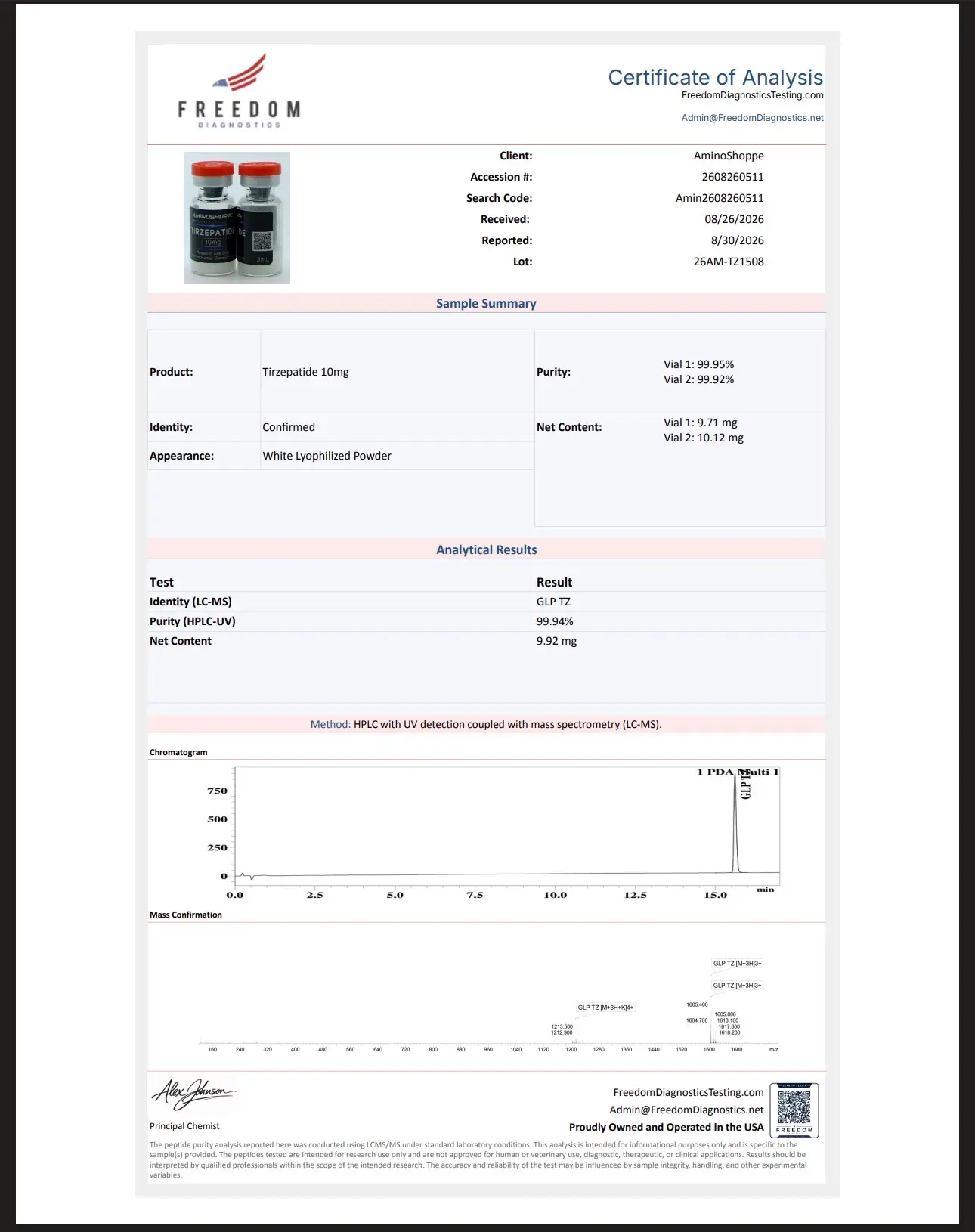
Documentation should be reviewed before a material enters inventory. Researchers should confirm the product name, stated quantity, batch or lot identification, test method where provided, and certificate of analysis availability. A certificate of analysis is not a substitute for internal laboratory controls, but it is an essential supplier-side record for evaluating identity and stated purity specifications.
The following categories reflect common areas of peptide and bioactive compound research. They are not clinical recommendations, veterinary guidance, or instructions for human or animal administration. All materials discussed should be handled only by qualified personnel in legitimate laboratory research settings.
Metabolic Signaling Compounds
Retatrutide and Tirzepatide
Retatrutide and Tirzepatide are commonly evaluated in metabolic signaling research because of their relevance to incretin-related receptor systems. Their research value lies in the ability to examine receptor activity, downstream signaling behavior, comparative potency, selectivity questions, and effects within controlled cell-based or biochemical models.
These compounds are often discussed together, but they should not be treated as interchangeable. Their receptor activity profiles differ, which can materially affect study design and interpretation. A project investigating comparative signaling, receptor cross-reactivity, or pathway-specific response may benefit from evaluating both under a defined analytical framework. A narrower study focused on one receptor system may require only the compound that best matches the target.
For this category, confirm that the experimental model can distinguish the intended pathway from general stress, media effects, or unrelated signaling changes. Identity confirmation and traceable lot documentation are particularly important when comparing compounds across a panel.
5Amino
5Amino is generally considered in research involving cellular metabolism, enzyme-related pathways, and bioenergetic questions. It is not a peptide, which is an important distinction for laboratories organizing materials by chemical class. However, it may be relevant in broader peptide-adjacent research programs where metabolic modulation is evaluated alongside peptide signaling or mitochondrial response.
Its inclusion should be driven by the study hypothesis, not by catalog proximity. If a project requires a non-peptide comparator or a tool compound for examining metabolic pathway response, 5Amino may warrant consideration. If the research question is strictly peptide structure-function behavior, it may not be the appropriate material.
Mitochondrial Research Compounds
SS-31
SS-31 is a mitochondrial-targeted peptide frequently considered for research involving mitochondrial function, oxidative stress markers, membrane-associated processes, and cellular energy response. Its utility depends on whether the laboratory can measure mitochondrial endpoints with sufficient specificity.
Mitochondrial studies are sensitive to experimental conditions. Cell type, culture state, assay timing, vehicle controls, and baseline metabolic activity can all influence results. Researchers should avoid interpreting a single viability or fluorescence result as a complete assessment of mitochondrial activity. Orthogonal methods and well-defined controls provide a more reliable basis for analysis.
MOTS-C
MOTS-C is another compound of interest in mitochondrial and metabolic research. It may be relevant to projects examining cellular adaptation, metabolic signaling, and mitochondrial-nuclear communication concepts. Because these research areas often involve interconnected pathways, a clear primary endpoint is necessary before selecting MOTS-C.
Where SS-31 may be selected for a project centered on mitochondrial structural or stress-related questions, MOTS-C may fit a different hypothesis related to metabolic signaling or adaptive cellular response. The appropriate choice depends on the model and endpoint. Researchers should document the rationale for each compound in the study plan rather than grouping both under a broad mitochondrial label.
Tissue, Repair, and Matrix Research Peptides
BPC 157
BPC 157 is often requested for exploratory research involving tissue-associated signaling, cellular migration, extracellular matrix questions, and inflammatory pathway models. Its visibility in the research materials market does not eliminate the need for a precise use case. A study should define the measurable endpoint, such as a controlled in vitro marker, before the compound is acquired.
Researchers should also recognize that tissue-related research can be highly model-dependent. Findings from one cell line or assay format may not translate to another. Compound quality, solvent selection, material handling, and the use of proper negative and positive controls can all affect whether observed results are interpretable.
GHK-Cu
GHK-Cu is a copper-binding tripeptide that may be relevant to research on matrix biology, peptide-metal interactions, cellular signaling, and cosmetic or dermatologic research models. The copper component makes experimental context especially important. Researchers should account for background metal content in media, buffers, and assay systems when designing studies.
GHK-Cu is not simply a substitute for a non-metal-binding peptide. Its coordination chemistry may influence the experimental behavior being observed. Laboratories evaluating it should consider whether the study is intended to measure peptide-specific activity, copper-associated effects, or the interaction between both variables.
Supporting Materials Are Not Interchangeable
NAD+ 500mg and bacteriostatic water may appear alongside peptide research materials, but they serve different roles and should not be classified as peptide research compounds.
NAD+ is a cofactor used in research related to redox biology, metabolism, and enzymatic activity. It may be useful as a comparator or supporting material in studies involving metabolic or mitochondrial pathways, including projects that also examine peptides such as SS-31 or MOTS-C. Its relevance should be justified by the study design, not assumed because the broader topic is cellular energy.
Bacteriostatic water is a handling material, not an active research analyte. Laboratories should follow their internal procedures, product-specific instructions, and applicable institutional requirements when determining whether a particular diluent or handling material is appropriate. Do not assume that one preparation approach is suitable for every compound, assay, or storage condition.
Quality Controls That Belong Before Purchase
Before selecting from a supplier catalog, laboratories should establish a minimum acceptance checklist. The core review should include product identity, available certificate of analysis, stated purity information, lot traceability, packaging condition, storage guidance, and the supplier’s research-use-only policy. For highly sensitive experiments, the laboratory may also need independent identity or purity verification as part of its own quality system.
At AMINOSHOPPE, research materials are positioned for laboratory research only, with emphasis on U.S. lab testing and certificate-of-analysis review. Buyers should verify the current product documentation associated with the specific item and lot under consideration rather than relying on general product familiarity.
Procurement decisions should also account for the amount of material required across method development, controls, repeat runs, and analytical confirmation. Ordering only enough for a single unreplicated experiment can create avoidable variability if a later lot must be introduced before the work is complete.
Select for the Question, Then Verify the Material
The strongest peptide research purchases are tied to a narrow, documented purpose. Retatrutide or Tirzepatide may fit a metabolic receptor question. SS-31 or MOTS-C may fit a mitochondrial or cellular energy hypothesis. BPC 157 and GHK-Cu may be relevant to defined tissue, matrix, or peptide-metal research models. Supporting materials such as NAD+ or bacteriostatic water require separate justification because they are not interchangeable with peptides.
Choose the compound only after the target, assay, controls, documentation requirements, and storage plan are clear. That discipline keeps research materials aligned with the work they are actually intended to support.
Related Posts

BPC 157 Research Peptide Buying Criteria
A BPC 157 research peptide should be evaluated as a…

How to Buy Lab Tested Peptides for Research
A peptide listing can look credible while providing no way…

How to Review Peptide Listings Before Purchase
A peptide listing can look complete while still leaving out…