A peptide listing can look credible while providing no way to verify what is in the vial. Knowing how to buy lab tested peptides starts with treating the purchase as a research-procurement decision, not a consumer supplement purchase. The relevant questions are specific: Can the supplier document the lot? Does the certificate match the product and batch? Are the material’s intended use, storage conditions, and handling boundaries stated clearly?
For qualified adult purchasers obtaining materials for legitimate laboratory research, lab testing is a meaningful quality-control signal. It is not a substitute for laboratory-specific qualification, method validation, or proper safety practices. Research-use-only materials are not intended for human or animal consumption, diagnostic use, therapeutic use, or clinical application.
Start With the Intended Research Use
Before comparing suppliers, define what the material must support in your research workflow. Record the compound name, required quantity, acceptable salt or form, target purity specification, and the analytical documentation your work requires. A procurement record should also identify storage capability, internal receiving procedures, and any institutional or local requirements that apply to your laboratory.
This matters because a product name alone is not a complete specification. Peptide nomenclature can be similar across products, while molecular form, amount per vial, stated purity, and available documentation may differ. A compound suitable for one exploratory research protocol may not meet the documentation requirements of a more controlled analytical workflow.
Do not purchase material based solely on an abbreviated name, a product image, or a broad purity claim. Confirm the exact product identity before checkout. If the listing does not make the material, quantity, and research-only status clear, it leaves too much uncertainty for a serious buyer.
How to Buy Lab Tested Peptides: Review the COA First
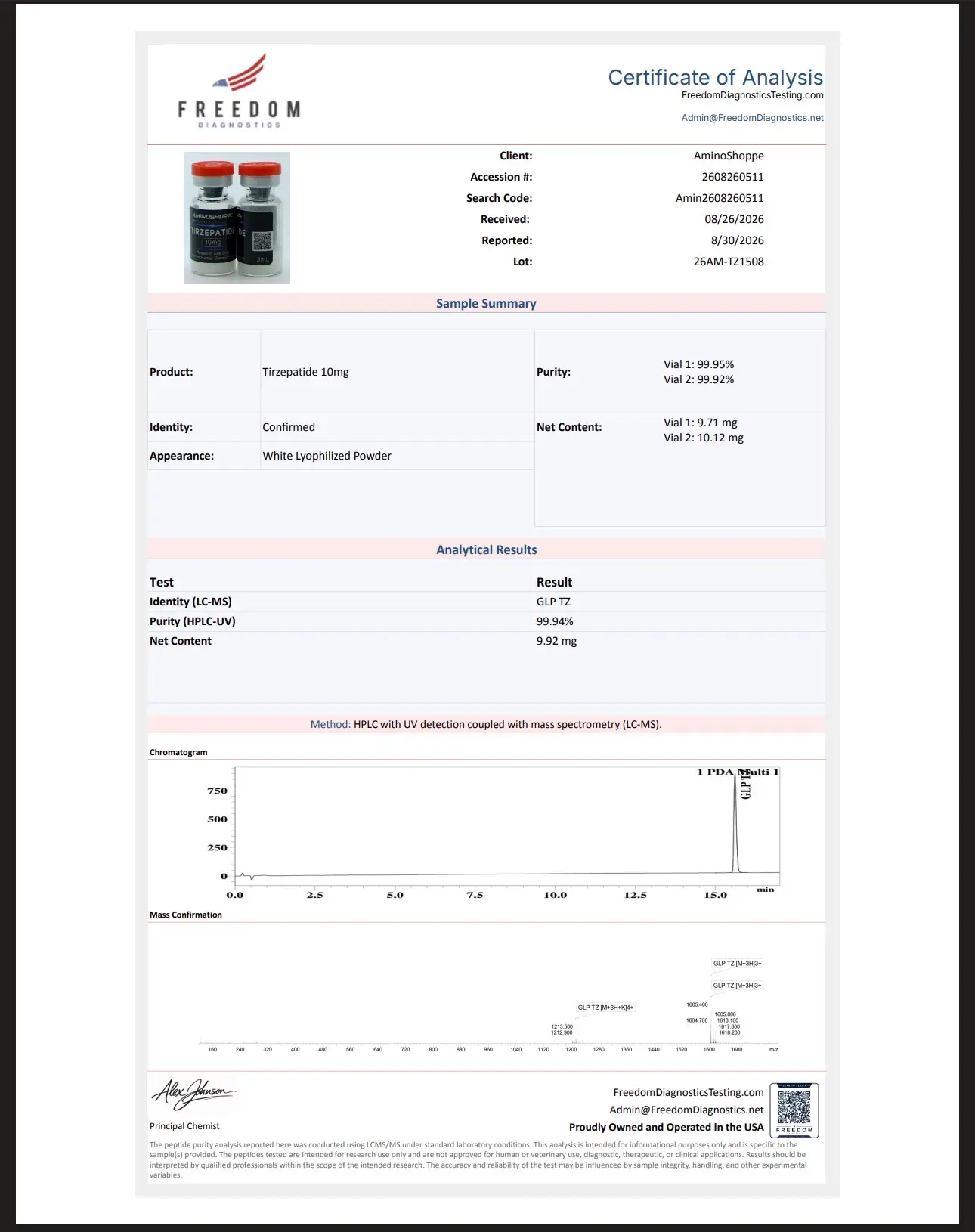
A certificate of analysis, commonly called a COA, should be central to the purchasing decision. It provides a documented record of testing associated with a material or batch. The most useful COAs are specific rather than generic. A reusable template that is not tied to the item being sold offers far less value than a report that identifies the relevant lot.
Review whether the COA includes the compound name, lot or batch number, date of analysis, testing method, result, and stated specification. The lot number is particularly important. It should allow you to connect the document to the vial or package you receive. If a supplier publishes testing information, confirm that the documentation aligns with the product variant and current inventory rather than assuming one report applies to every lot indefinitely.
For peptides, commonly referenced analytical methods may include HPLC for purity assessment and mass spectrometry for identity-related confirmation. These methods answer different questions. A purity percentage does not, by itself, establish every aspect of material identity, concentration, sterility, stability, or suitability for a particular study. Likewise, identity data does not eliminate the need to understand impurity profiles or handling limits.
Read reported results in context. A high stated purity can be relevant, but it should not be used as shorthand for universal quality. Testing scope, sample preparation, laboratory methods, and the supplier’s lot-control practices all affect what a COA can reasonably demonstrate. Documentation should support informed purchasing, not replace your laboratory’s own incoming-material procedures.
Evaluate Supplier Controls, Not Just Test Results
A single report is one part of a broader quality picture. Look for a supplier that makes its operating boundaries clear: research-use-only labeling, age-gated access where appropriate, transparent product descriptions, documented testing practices, and defined policies for order handling.
A credible research-material supplier should avoid medical promises and should not frame compounds as products for personal administration. Claims that a peptide will treat a condition, produce a physiological outcome, or provide a dosage result are incompatible with a compliance-focused research supply model. Such language is a reason to pause, not a reason to buy.
Clear product pages also matter. Buyers should be able to determine the listed quantity, price, available options, and applicable handling information without relying on assumptions. AMINOSHOPPE, for example, emphasizes research-only positioning and U.S. lab-test documentation as part of its product-verification approach. Regardless of supplier, review the actual documentation associated with the product you intend to order.
Be cautious with vague phrases such as “pharmaceutical grade” when no supporting method, specification, or lot-specific paperwork is available. The phrase may be used inconsistently across online marketplaces. Procurement decisions should rest on traceable documentation and appropriate specifications, not marketing terminology.
Confirm Packaging, Storage, and Receipt Procedures
Quality can be compromised after testing if material is mishandled in transit or upon receipt. Before placing an order, review the supplier’s stated packaging and shipping practices, then compare them with the compound’s storage requirements and your receiving capacity. Some materials require controlled storage conditions, and the buyer should be prepared to receive and transfer them promptly according to the supplied guidance.
At receiving, inspect the shipment before placing the material into inventory. Confirm the product name, quantity, lot number, vial integrity, label legibility, and any accompanying documentation. Record the receipt date and retain the COA with your internal inventory record. If a lot number does not match available documentation, or if packaging is compromised, isolate the material and contact the supplier before use in research.
Avoid creating a false sense of security from packaging alone. A sealed vial does not independently verify identity or purity. Packaging is one control among several: supplier documentation, lot traceability, appropriate storage, and laboratory verification where your protocol requires it.
Compare Price Only After Comparing Specifications
Lower pricing may be attractive, especially for early-stage or independent research, but it should be compared against the full purchase requirement. A lower-cost product with no lot-specific COA, unclear quantity, or inconsistent labeling can create more cost and delay than a properly documented material. Reordering, repeating work, or resolving a traceability issue can quickly outweigh a modest price difference.
Conversely, the highest price does not automatically indicate the strongest controls. Compare what is actually supplied: the amount of material, stated specification, analytical documentation, batch traceability, packaging details, and the supplier’s research-only compliance posture. This makes the comparison operational rather than promotional.
For recurring purchases, retain records from each order. Over time, those records help your laboratory assess consistency across lots and suppliers. They also make it easier to identify documentation gaps before they affect a project timeline.
Questions to Resolve Before Checkout
A purchase should be ready to proceed only when the core facts are available. Verify the exact compound and amount, the research-only designation, the lot-specific or otherwise applicable COA, the reported analytical methods and results, and the stated storage and handling information. Confirm that your facility can receive the shipment appropriately and that your planned work falls within legitimate research boundaries.
If any of these points is unclear, request clarification before ordering. Responsible suppliers should be able to explain what their documentation covers and should avoid overstating what it proves. A careful question before checkout is preferable to an unsupported assumption after the material arrives.
The best purchasing habit is simple: buy only what your research plan can document, receive, store, and evaluate responsibly. That discipline protects the integrity of the work long after the order is placed.
Related Posts

What Is Certificate of Analysis COA?
A product listing can say 99% purity, third-party tested, or…

What Does US Lab Tested Mean for Research?
A product page marked “US lab tested” is making a…

How to Verify Peptide Supplier Legitimacy
A peptide listing can look credible while providing very little…