Retatrutide vs tirzepatide research is often reduced to a simple question of which compound produces a larger effect. That framing is not sufficient for qualified research settings. These molecules differ in receptor targets, clinical development status, evidence maturity, and the controls required to interpret findings without overstating them. A useful comparison begins with mechanism, then separates published human data from the properties of any research material under evaluation.
Both compounds are incretin-based peptides studied for metabolic applications. That shared category does not make them equivalent reagents, interchangeable protocols, or interchangeable clinical candidates. Research conclusions should remain limited to the specific compound, lot, assay, and experimental conditions evaluated.
Retatrutide vs Tirzepatide Research: Mechanism
Tirzepatide is a dual agonist designed to activate glucose-dependent insulinotropic polypeptide (GIP) and glucagon-like peptide-1 (GLP-1) receptors. GIP and GLP-1 signaling have established relevance to glucose regulation, insulin secretion under glucose-dependent conditions, appetite-related pathways, and energy balance. The dual-agonist profile is central to tirzepatide research and to the substantial clinical evidence base built around the molecule.
Retatrutide extends the receptor profile. It is designed as a tri-agonist, targeting GIP, GLP-1, and glucagon receptors. The glucagon receptor component is the principal mechanistic distinction. In research terms, this adds a pathway associated with hepatic glucose handling and energy expenditure, while also creating additional variables that must be characterized rather than assumed to be favorable across all models.
The difference between dual and triple agonism matters because receptor activity is not a simple on-off property. Relative potency, receptor selectivity, signaling bias, exposure profile, species-specific receptor biology, and assay design can all affect observed results. A finding in one cell system or animal model cannot establish the same response in another system, and it cannot establish a human outcome.
Why glucagon activity changes the research question
The glucagon receptor is not merely a third label on retatrutide. Its inclusion changes the hypotheses being tested. A laboratory may examine whether combined signaling affects lipid metabolism, energy expenditure markers, hepatic pathways, feeding behavior, or other metabolic endpoints differently from GIP/GLP-1 agonism alone.
It also changes the need for controls. Depending on the model and endpoint, investigators may need to account for changes in glucose-related measures, cardiovascular observations, food intake, body composition, liver-associated signals, and compensatory endocrine responses. The appropriate panel depends on the protocol. The key point is that a more complex pharmacologic profile requires more disciplined interpretation, not broader claims.
Evidence Maturity and Development Status
Tirzepatide has a more mature clinical evidence base than retatrutide. Its development program has included large studies across metabolic indications, providing investigators with more extensive information on efficacy endpoints, adverse-event patterns, tolerability, and population-specific study designs. In the United States, tirzepatide is also available in FDA-approved prescription products for specified uses. That regulatory status applies to those approved drug products only.
Retatrutide remains an investigational clinical candidate. Early and mid-stage clinical research has generated substantial interest because reported weight-related and metabolic outcomes have been notable, but investigational findings are not a substitute for completed confirmatory evidence or regulatory review. Study duration, participant selection, dose escalation, retention, endpoint definitions, and adverse-event reporting all shape what a result can reasonably support.
For procurement and laboratory planning, this distinction is practical. Tirzepatide may be selected when the objective is to study a dual GIP/GLP-1 reference mechanism with a deeper published record. Retatrutide may be selected when the hypothesis specifically concerns tri-agonist signaling or the incremental contribution of glucagon receptor activity. Neither choice should be presented as a determination of clinical superiority.
Avoiding false equivalence in study design
Direct comparisons require more than placing both compounds in the same experiment. Concentration selection, exposure timing, receptor expression, matrix effects, comparator rationale, and analytical validation can materially influence results. Equal mass concentration does not necessarily represent comparable receptor engagement, and a single endpoint rarely captures the full distinction between the two compounds.
Where the goal is receptor-level characterization, separate assays for GIP, GLP-1, and glucagon receptor activity can provide more interpretable data than a broad metabolic endpoint alone. Where the goal is downstream pathway analysis, researchers should predefine the expected mechanism, relevant biomarkers, and criteria for distinguishing signal from assay variability.
Published clinical data should also be handled with precision. Results from separate trials are not head-to-head evidence merely because both studies measured body weight or glycemic outcomes. Differences in eligibility criteria, baseline characteristics, trial duration, adherence, background intervention, and statistical analysis may account for apparent differences between programs.
Material Quality Is Part of the Experimental Result
For research-use-only peptides, compound identity and lot consistency are foundational. A receptor assay cannot correct for an incorrectly identified material, degraded peptide, unexpected impurity profile, or concentration error. Documentation should be reviewed before a material enters a protocol, not after an unexpected result appears.
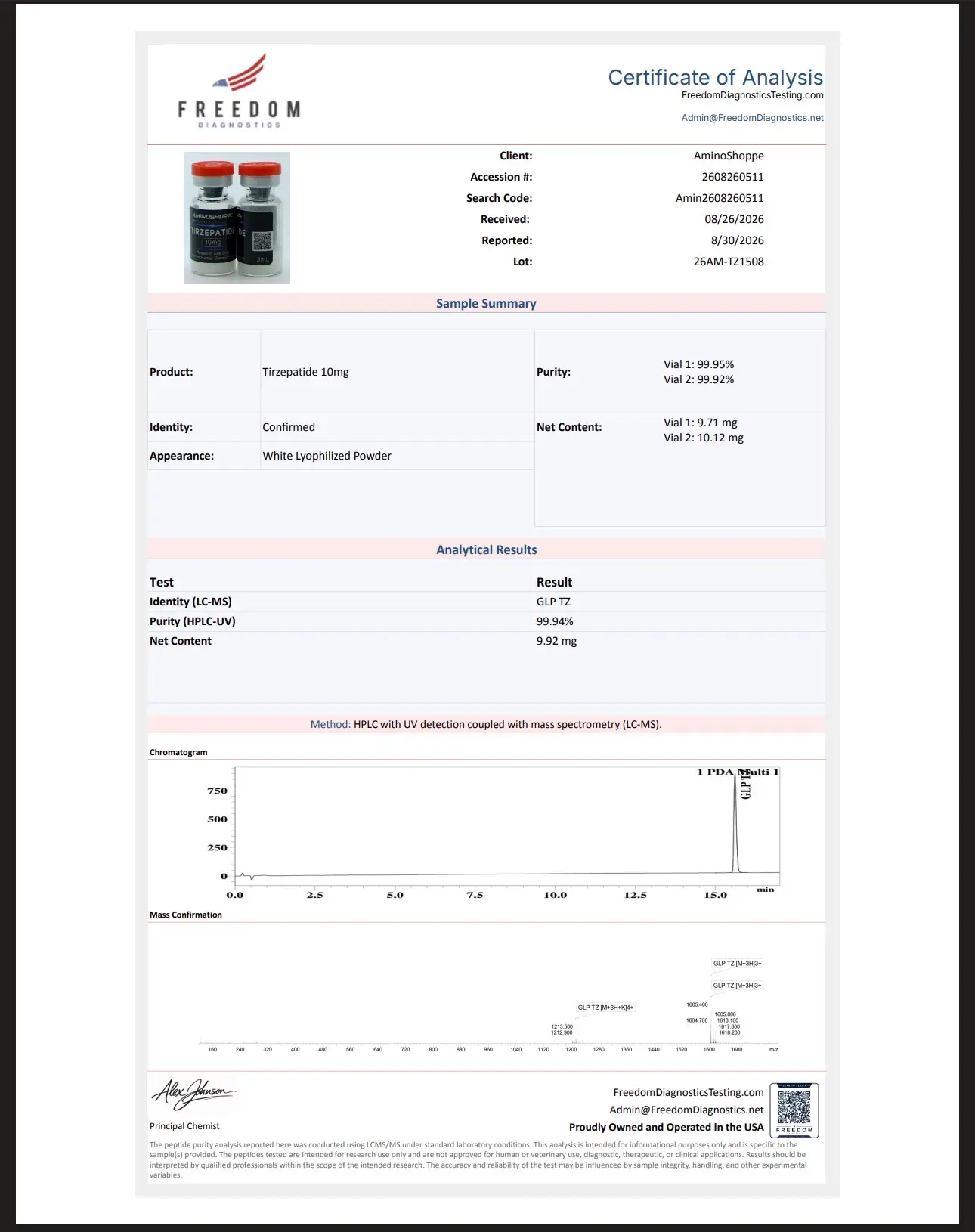
A certificate of analysis can support review of reported identity, purity, and associated analytical testing for a specific lot. It does not validate a research hypothesis, establish biological activity in a given assay, or remove the need for incoming-material controls. Researchers should confirm that lot identifiers on the documentation align with the material received and retain records within the study file.
Appropriate laboratory controls may include an independently characterized reference where available, blank matrices, vehicle controls, repeat measurements, stability assessments suited to the protocol, and defined acceptance criteria. Analytical methods should be selected based on the question being asked. Identity confirmation, purity assessment, and concentration verification are related but distinct quality considerations.
AMINOSHOPPE supplies materials designated exclusively for laboratory research. Products are not approved drugs and are not intended for human or animal consumption, diagnostic use, therapeutic use, or personal administration. Buyers are responsible for ensuring that acquisition, storage, handling, documentation, and disposal are consistent with applicable institutional requirements and law.
Practical Selection Criteria for Qualified Research Buyers
The most defensible selection process starts with the protocol rather than market interest. If a project requires a dual GIP/GLP-1 agonist model, tirzepatide is the direct mechanistic fit. If the protocol is designed to isolate or explore tri-agonist behavior, retatrutide may be the appropriate candidate. The choice should be based on receptor pharmacology and a defined endpoint, not on broad claims derived from unrelated studies.
Before purchase, review the available lot documentation, required material quantity, storage capability, analytical workflow, and controls. Confirm whether the planned assays can distinguish expected receptor-mediated activity from nonspecific or matrix-driven effects. If the study is intended to compare compounds, establish in advance how exposure, normalization, replicates, and data exclusion will be handled.
Researchers should also separate product documentation from clinical literature. A supplier’s certificate of analysis addresses attributes of the supplied lot. Clinical publications address outcomes under controlled clinical protocols. Neither category of information should be used to make claims that belong to the other.
The Appropriate Research Question
The useful question in retatrutide vs tirzepatide research is not which name is more compelling. It is whether a dual GIP/GLP-1 agonist or a GIP/GLP-1/glucagon tri-agonist is the correct tool for the receptor pathways and endpoints defined in the protocol.
That decision may change as evidence develops, but disciplined research does not wait for a headline to define the method. It begins with verified material, documented controls, a mechanism-specific hypothesis, and conclusions no broader than the data can support.
Related Posts

Bacteriostatic Water Review for Research Buyers
A bacteriostatic water review should begin with a basic procurement…

BPC 157 COA Standards for Research Buyers
A BPC 157 certificate of analysis is not merely a…

How to Store Research Peptides for Lab Stability
A peptide can arrive with strong analytical documentation and still…