A mislabeled vial, incomplete certificate, or undocumented storage condition can compromise weeks of laboratory work before an experiment even begins. Selecting a research peptide supplier is therefore a procurement decision, not a marketing exercise. The right supplier provides clear product identification, meaningful quality documentation, defined handling boundaries, and a purchasing process appropriate for legitimate research use.
For laboratories, independent researchers, and technically informed buyers, the question is not simply whether a compound is available. It is whether the material can be evaluated, received, documented, and handled with enough confidence to support the intended research workflow.
What a Research Peptide Supplier Should Provide
A qualified supplier should make the essential facts of a product easy to locate before purchase. At minimum, buyers should be able to identify the compound name, stated quantity, format, research-use designation, and available analytical documentation.
Product naming matters. Peptide nomenclature can be precise, while product labels and listings may vary across the market. A buyer should be able to determine exactly what is being offered without relying on vague descriptions, wellness-oriented claims, or implied outcomes. Listings should identify the research material directly and avoid language that suggests products are intended for diagnosis, treatment, prevention, or consumption.
The supplier’s operating boundaries matter just as much. Research peptides and related bioactive compounds should be clearly designated for laboratory research only, not for human or animal consumption. Direct compliance language is not a cosmetic feature. It signals that the supplier understands the distinction between research materials and regulated therapeutic products.
Start With Documentation, Not Product Claims
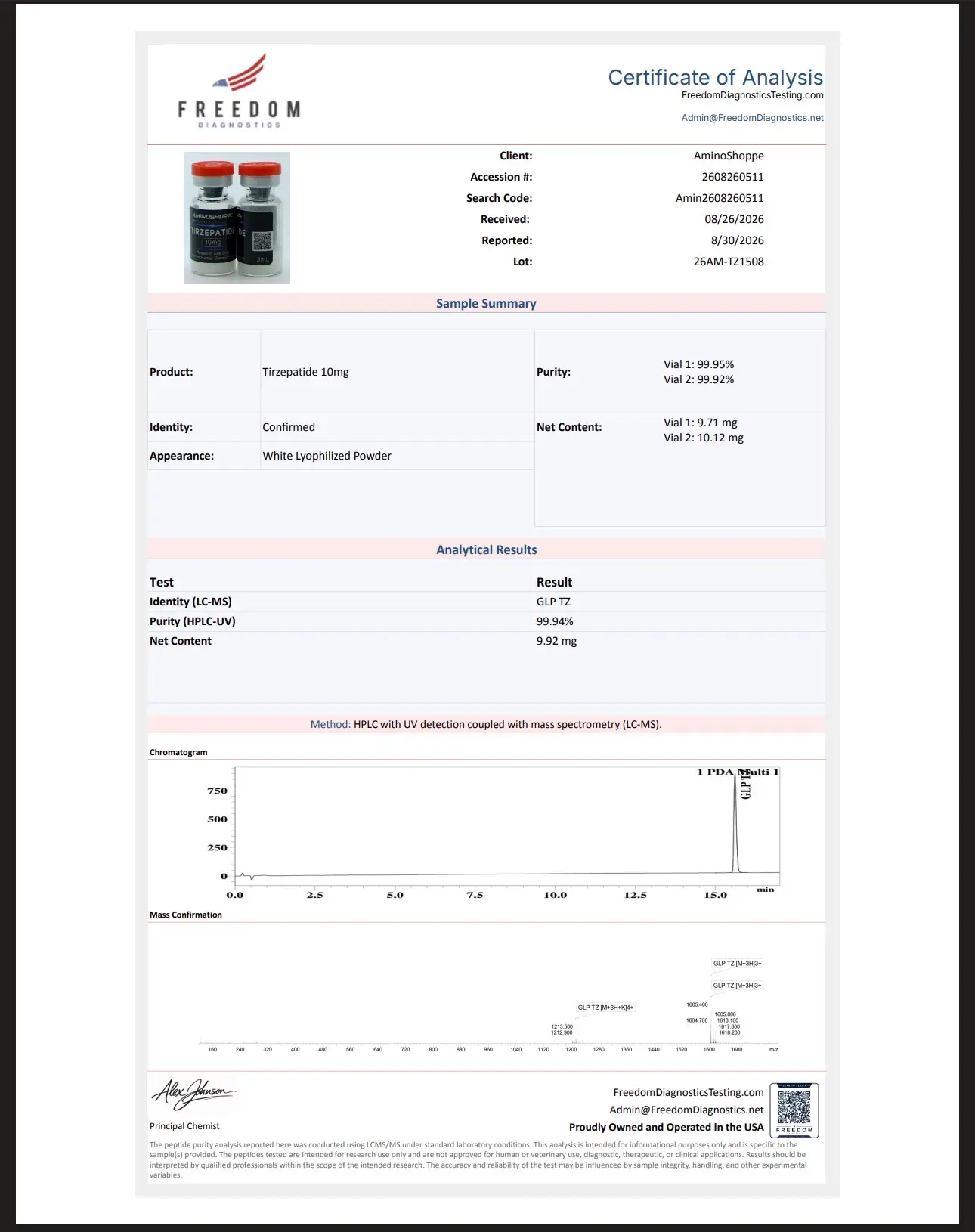
Certificates of analysis are among the most useful trust signals in specialty research procurement, but they need to be reviewed in context. A certificate should identify the material tested and present relevant analytical results in a readable format. Depending on the material and testing approach, buyers may see reported purity, identity-related data, batch or lot information, testing dates, and laboratory details.
A certificate alone does not eliminate the need for internal controls. It is supporting documentation, not a substitute for method validation, incoming-material procedures, or independent confirmation when a study requires it. The appropriate level of verification depends on the research application, the consequence of failure, and the laboratory’s own quality system.
When reviewing documentation, assess whether it answers practical questions:
- Does the document identify the same compound and lot associated with the product being purchased?
- Is the stated purity presented with a test method or other meaningful analytical context?
- Is the certificate legible, specific, and consistent with the product listing?
- Does the supplier make quality information available without requiring speculative claims about performance?
Batch-level documentation is generally more useful than broad statements such as “high purity” or “premium grade.” Quality language should be supported by information a buyer can examine. For research compounds, transparency is more valuable than exaggerated certainty.
Understand What Purity Does and Does Not Mean
A reported purity percentage can be relevant, but it is not the entire quality picture. Purity may refer to the proportion of a material measured under a specific analytical method. It does not automatically establish suitability for every assay, stability under every condition, sterility, endotoxin status, or compatibility with a particular solvent or protocol.
Researchers should avoid treating a single number as a universal approval signal. Materials intended for sensitive analytical, cellular, or other specialized workflows may require additional internal assessment. Storage, reconstitution choices, handling time, and repeated freeze-thaw exposure can also affect experimental consistency after receipt.
Evaluate Product Information and Catalog Discipline
A credible research peptide supplier maintains a catalog that is organized around identifiable research materials rather than broad promises. Buyers should be able to distinguish among peptides, mitochondrial research compounds, cofactors, and supporting laboratory materials without ambiguity.
For example, a catalog may include compounds such as Retatrutide, Tirzepatide, SS-31, MOTS-C, BPC 157, GHK-CU, NAD+ 500 mg, or bacteriostatic water. Availability does not make these materials interchangeable. Each has distinct research contexts, handling considerations, and documentation needs. Product selection should begin with the study design and material specification, not with a compound’s popularity online.
Product pages should also communicate package size and form clearly. A buyer needs to know whether a listing is supplied as a lyophilized material, solution, or ancillary laboratory product, as well as the stated quantity. This reduces avoidable ordering errors and helps procurement teams align the purchase with their established inventory and handling procedures.
Where storage guidance is provided, it should be treated as part of the product specification. Receiving teams should prepare for appropriate intake, inventory logging, and storage before delivery arrives. There is little value in carefully reviewing documentation if chain-of-custody and storage practices are ignored at the point of receipt.
Check Supplier Practices Beyond the Product Page
Product quality is assessed through more than a single listing. A supplier’s site structure, policies, and communication standards provide additional evidence of how seriously it approaches research-only distribution.
Look for consistent compliance language across the catalog and checkout process. A supplier should not describe products as research materials on one page while using consumption-oriented marketing elsewhere. Consistency is a practical signal of operational discipline.
Age-gated access and purchaser qualification language may also be relevant. These measures do not replace a buyer’s own responsibility to comply with applicable laws, institutional policies, and laboratory requirements. They do show that the supplier is attempting to maintain clear boundaries around access and use.
Transparent purchase logistics are similarly useful. Buyers should be able to understand how orders are placed, how products are presented, and where documentation can be located. For repeat procurement, predictable catalog structure and clear batch records can reduce administrative friction and support more reliable inventory management.
A supplier should also avoid making claims it cannot substantiate. Statements that imply human outcomes, dosing guidance, treatment use, or guaranteed experimental results are not appropriate for research-use-only materials. Strong suppliers focus on what can be documented: product identity, stated quantity, testing information, availability, and handling-related details.
Match Verification to the Risk of Your Work
Not every project requires the same level of supplier review. A preliminary exploratory workflow may have different procurement requirements than a study producing publishable data, a contract research program, or a highly sensitive analytical assay.
For lower-risk exploratory work, a clear product listing, lot-linked certificate of analysis, and defined research-only status may provide a reasonable starting point. For higher-consequence work, buyers may need more stringent controls, such as receiving inspection, retained samples, independent testing, expanded documentation review, or supplier qualification procedures required by their organization.
This is where procurement discipline matters. The supplier’s documentation should support your process, but it cannot replace it. Record the lot received, preserve accompanying quality records, inspect packaging on arrival, and document any discrepancy before using the material. If the material does not match the order or its documentation, pause the workflow and resolve the issue through the supplier before introducing it into research activity.
Questions Worth Asking Before Ordering
A careful buyer does not need an extended checklist for every routine order, but several questions should be answered before committing to a new supplier or material. Can the product and its quantity be identified precisely? Is analytical documentation available and connected to the relevant lot? Are research-use-only restrictions stated plainly? Does the supplier provide consistent information across product pages, policies, and ordering steps?
It is also reasonable to consider responsiveness. When a buyer requests clarification about documentation, packaging, or product status, the answer should be specific and aligned with the supplier’s published information. Vague assurances are less useful than a direct explanation of what documentation exists and what it does not establish.
A Procurement Standard Built for Research
The strongest purchasing decision is usually the least dramatic one: a correctly identified material, supported by accessible documentation, obtained from a supplier that maintains firm research-only boundaries. AMINOSHOPPE centers its catalog around that standard through documented laboratory materials, U.S. lab-testing emphasis, and clear research-use-only qualification.
Before placing an order, define what your workflow requires, verify the available records, and ensure your laboratory is prepared to receive and manage the material properly. Careful sourcing at the start gives the rest of the research process a more defensible foundation.
Related Posts

HPLC Versus Mass Spectrometry for Research
A chromatogram with one clean peak can be reassuring, but…

BPC 157 Research Peptide Buying Criteria
A BPC 157 research peptide should be evaluated as a…

A Practical Guide to Research Peptide Labeling
A labeled peptide can be easy to identify and still…