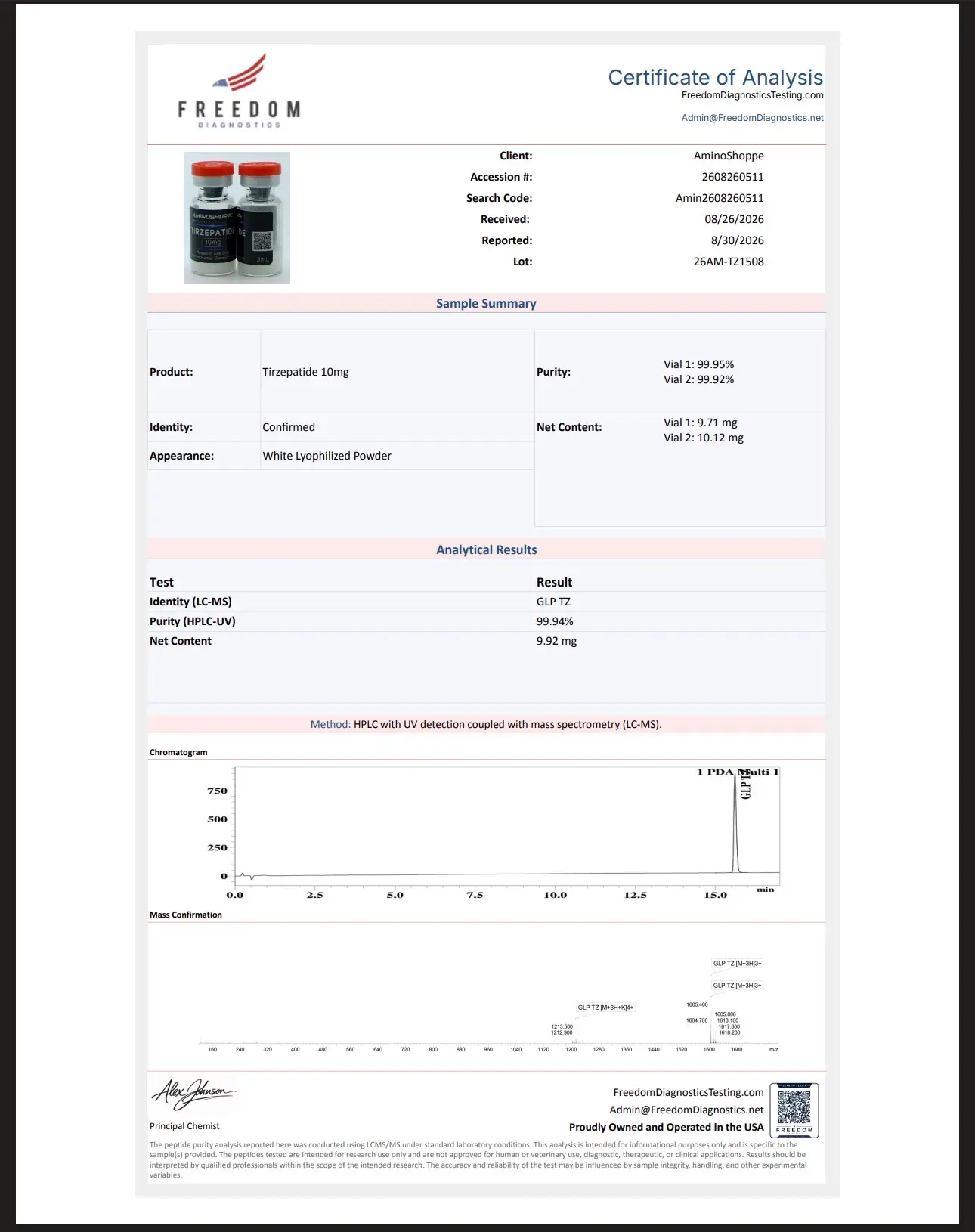
A certificate of analysis is not a marketing badge. For research buyers, it is a batch-specific quality document that should be reviewed before materials enter a workflow. This COA certificates guide explains what to look for, what a document can verify, and where additional questions are appropriate.
Research-use-only materials require disciplined purchasing decisions. A product name, stated purity percentage, or polished product page does not replace analytical documentation tied to the actual lot being offered. The most useful COA creates a clear chain between the material, the test method, the reported result, and the batch identifier.
What a COA Is Designed to Confirm
A certificate of analysis, commonly called a COA, reports analytical results for a defined sample or production lot. Depending on the material and test panel, it may address identity, purity, mass, residual solvents, moisture, microbial limits, endotoxin, or other relevant specifications.
For peptide research materials, a standard COA often centers on identity confirmation and purity testing. High-performance liquid chromatography, or HPLC, is commonly used to characterize purity profiles. Mass spectrometry may be used to support molecular identity. The correct combination of methods depends on the compound, its intended research application, and the supplier’s quality program.
A COA should be read as evidence for the tested lot, not as a universal statement about every vial, every future production run, or every possible experimental use. It also does not establish that a material is appropriate for human or animal administration. Research materials must be handled only within their stated research-use-only boundaries.
The Information a Complete COA Should Include
A useful document begins with traceability. The product or analyte name should be clear enough to identify the material under review. The lot or batch number should be present and should match the number shown on the product label, packaging, or supplier-provided batch record.
The report should also identify the testing laboratory or analytical provider. This does not always mean every laboratory uses the same format, but the document should provide enough information to determine who performed the work and when it was completed. A report date, sample receipt date, or analysis date helps establish whether the documentation is relevant to the lot being purchased.
Method reporting matters as much as the final percentage. A purity result without any stated analytical method provides limited context. For example, an HPLC purity result is more meaningful when the report identifies the method type, result, and any applicable acceptance criteria. A mass result is more useful when it indicates the observed value and the expected molecular mass or identity reference.
A properly structured COA will usually include the following core elements:
- Material name and batch or lot number
- Test date and report date
- Analytical method or methods used
- Specifications, results, and pass or fail status
- Laboratory identification and document authorization
Not every material requires the same panel. A lyophilized peptide, an NAD+ preparation, bacteriostatic water, and a mitochondrial research compound may require different methods, specifications, and handling considerations. Buyers should not assume that one test format applies equally to every catalog category.
How to Review Purity Results Without Overreading Them
Purity is often the first figure buyers look for, and it is valuable, but it needs context. A reported 99% HPLC purity means the tested sample met a stated chromatographic purity result under the laboratory’s method conditions. It does not automatically describe stability after shipment, storage history after receipt, formulation suitability, biological activity, or performance in a specific assay.
Review whether the result is tied to a defined specification. A report that states a result of 99.2% is stronger when the acceptance criterion is also shown, such as not less than 98%. The specification explains what standard the material was evaluated against. The result shows how the tested sample performed against that standard.
Chromatograms can add useful detail when included. A clean primary peak may support the stated purity result, while additional peaks can indicate detectable impurities or related species. Interpretation should remain proportionate. Small secondary peaks are not automatically disqualifying, but unexplained results, unclear axes, missing sample identification, or a chromatogram that cannot be connected to the reported lot deserve follow-up.
Identity Testing Is Not Optional Context
A purity percentage does not, by itself, confirm that the material is the intended compound. A sample can be highly pure while still being incorrectly identified. That is why identity testing is a separate and necessary part of quality review.
For many peptides, mass spectrometry is used to compare an observed mass with the expected molecular mass. The report may present the expected mass, observed mass, charge states, or a spectrum. The level of detail varies by laboratory, but the core question remains straightforward: does the analytical evidence support the stated identity?
Research buyers should verify that the material name, sequence or molecular description where relevant, and molecular-weight reference are internally consistent. A discrepancy may be a formatting issue, but it should not be ignored. Ask for clarification before ordering or using the lot in time-sensitive work.
Lot Matching Is the Most Practical Check
The strongest COA is of limited value if it cannot be tied to the physical material received. Before use, compare the lot number on the COA with the lot number on the vial, pouch, or outer label. Keep a copy of the document with internal receiving records and experimental documentation.
This check is particularly relevant when a supplier carries multiple vial sizes, concentrations, or lots of the same named compound. Product-level documentation may be helpful for preliminary evaluation, but lot-specific documentation is what supports traceability after purchase.
If a COA is posted before a product ships, confirm whether it represents the current available lot. If inventory rotates, request confirmation that the document corresponds to the batch being fulfilled. This is a routine procurement control, not an unreasonable request.
Questions to Ask When a COA Is Incomplete
A missing field is not always evidence of poor quality. Laboratories use different templates, and some reports are concise by design. Still, buyers should request clarification when the document does not establish identity, lot traceability, or the basis for the reported result.
Ask whether the report is batch-specific, which methods were used, and whether the results apply to the exact material being supplied. If sterility, endotoxin, residual solvents, or moisture are relevant to a research protocol, ask whether those attributes were tested and what specification was applied.
Do not assume unreported testing was performed. A COA only supports what it actually reports. Likewise, do not treat a generic sample report, an undated screenshot, or a certificate without a lot number as equivalent to current batch documentation.
Document Control and Storage Matter After Delivery
Quality verification does not end when the order is received. Record the lot number, receipt date, storage condition, and associated COA before the material is opened or aliquoted. If the material is divided among projects, preserve the batch reference in each internal record.
Storage and handling should follow the supplier’s stated requirements. A COA reflects the condition of the tested sample at the time of analysis. It cannot account for degradation caused by improper storage, repeated temperature exposure, contamination after opening, or use outside documented laboratory procedures.
For independent and small-lab research settings, a simple document-control process can prevent avoidable confusion. Maintain one folder or controlled record for purchase details, the COA, labeling photographs if needed, and any correspondence regarding lot confirmation. This is especially useful when repeating an experiment months later or comparing results across batches.
COAs Support Decisions, Not Assumptions
A certificate of analysis is one part of a quality decision. It should be considered alongside supplier transparency, lot traceability, stated storage requirements, packaging integrity, and the specific needs of the research protocol. The appropriate level of scrutiny depends on the material and the consequences of an inconsistent result.
AMINOSHOPPE maintains a research-use-only position and emphasizes laboratory testing documentation because buyers need evidence that can be reviewed, retained, and matched to product lots. That evidence is most valuable when the buyer reads it critically rather than treating it as a checkbox.
Before placing your next order, review the available COA as you would any other research record: confirm the lot, confirm the method, confirm the result, and retain the document with your laboratory files.
Related Posts

COA Versus Chromatogram Data: What Matters?
A vial label and a single purity percentage are not…

How to Review Peptide Listings Before Purchase
A peptide listing can look complete while still leaving out…