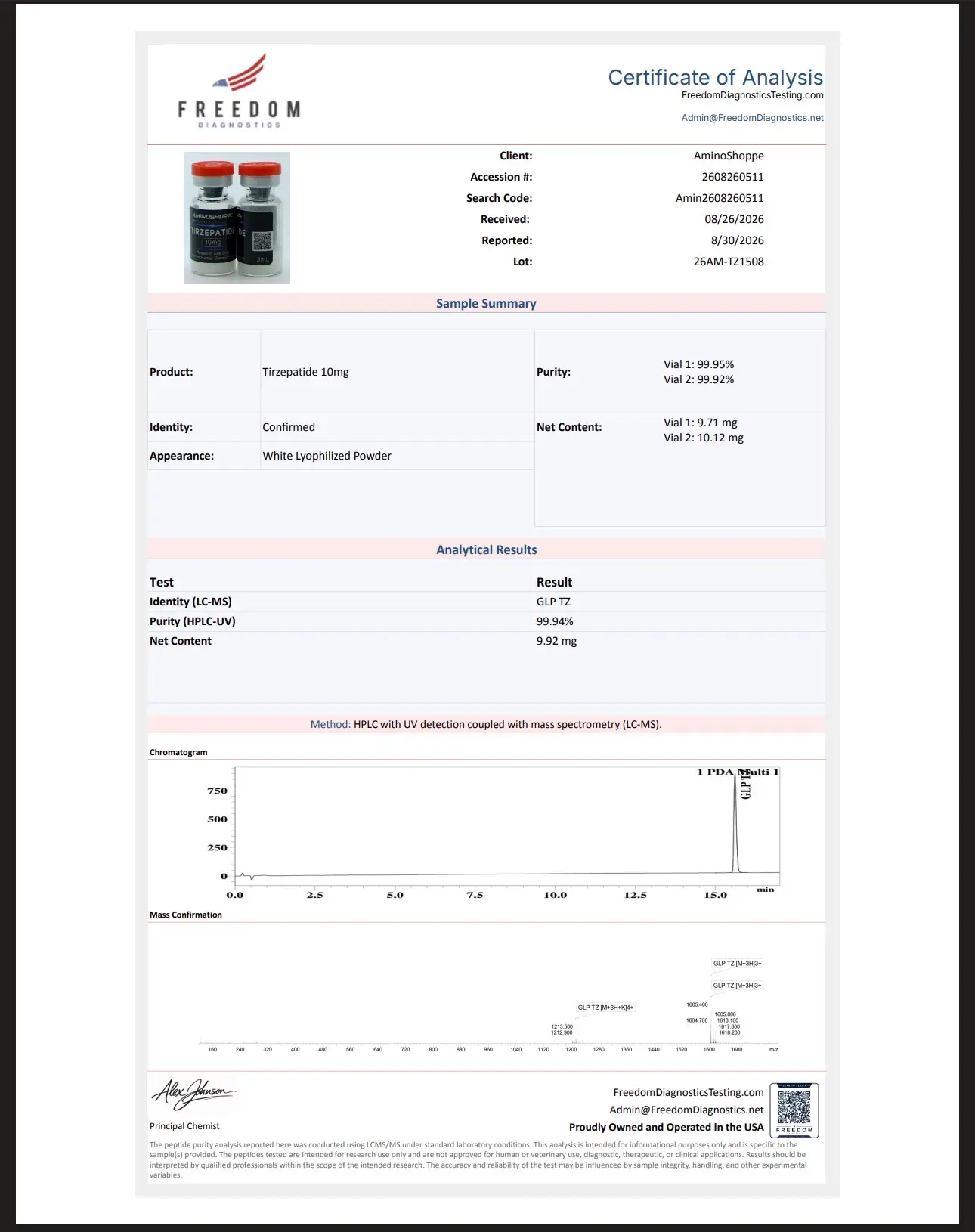
A chromatogram with one clean peak can be reassuring, but it does not independently establish molecular identity. That distinction is central to HPLC versus mass spectrometry. HPLC separates constituents within a sample; mass spectrometry measures ions by mass-to-charge ratio and can provide identity-related evidence. In many research workflows, the appropriate choice is not one method or the other. It is HPLC paired with mass spectrometry.
For laboratories evaluating specialized research materials, the analytical question should come before the instrument selection. Is the objective to assess chromatographic purity, confirm an expected molecular mass, investigate an unknown impurity, or quantify a known analyte in a complex matrix? Each objective carries different requirements for sample preparation, method development, reference standards, reporting, and data review.
What HPLC Measures
High-performance liquid chromatography, commonly called HPLC, is a liquid-phase separation technique. A prepared sample is injected into a mobile phase and carried through a column containing a stationary phase. Sample components interact with the column differently, causing them to elute at different retention times.
The resulting chromatogram displays detector response over time. With a UV detector, the response is based on light absorbance at a selected wavelength. This approach is widely used because it is practical, repeatable, and well suited to routine purity evaluation when a compound has an appropriate chromophore.
For a peptide or small-molecule research material, reversed-phase HPLC is frequently used to assess the relative distribution of chromatographically resolved components. A main peak may be reported as an area percentage under defined method conditions. That result is useful, but it requires disciplined interpretation. Peak area percentage is not automatically equivalent to absolute purity, and a single HPLC method may not resolve every possible impurity.
Retention time can support identification when compared with a qualified reference material under the same conditions. On its own, however, it is not a definitive identifier. Different compounds can sometimes produce similar retention behavior, particularly when methods are not optimized for selectivity.
Where HPLC Is Especially Useful
HPLC is a practical primary tool when the laboratory needs routine lot-to-lot comparison, chromatographic purity screening, stability-indicating separation, or quantitative analysis using validated calibration standards. It is also valuable for monitoring synthesis, evaluating degradation patterns, and assessing whether a sample profile is consistent with an established specification.
Method conditions matter. Column chemistry, mobile-phase composition, gradient, flow rate, temperature, detection wavelength, injection volume, and integration settings can all change the reported result. A purity value should therefore be reviewed alongside the method description rather than treated as a universal property independent of conditions.
What Mass Spectrometry Measures
Mass spectrometry, or MS, converts sample molecules into gas-phase ions and measures those ions according to their mass-to-charge ratio, written as m/z. The output is a mass spectrum rather than a chromatogram alone. Depending on the analyzer and acquisition mode, the data may show molecular ions, multiply charged ions, fragments, adducts, isotopic patterns, and other diagnostic features.
For intact peptides, electrospray ionization mass spectrometry is commonly used because peptides often form multiple charge states. Deconvolution can convert the observed charge-state envelope into an estimated neutral molecular mass. Agreement with the expected mass provides strong supporting evidence that the material corresponds to the expected molecular composition.
MS can also detect components that have limited UV response, which is a meaningful advantage in some impurity investigations. Tandem mass spectrometry, or MS/MS, adds another layer of information by isolating a selected precursor ion and generating fragment ions. Fragmentation patterns can support sequence confirmation, structural characterization, or identification of selected impurities.
Mass spectrometry still has limits. An accurate mass match does not necessarily prove full structural identity. Isomers can share the same exact mass, and some sequence or stereochemical differences may require targeted chromatographic separation, MS/MS interpretation, comparison against standards, or orthogonal techniques. Matrix effects, ion suppression, adduct formation, and in-source fragmentation can also influence results.
HPLC Versus Mass Spectrometry: The Practical Difference
The cleanest distinction is functional. HPLC answers, “What components can be separated under this method, and in what relative amount?” Mass spectrometry answers, “What ions are present, and what molecular-mass or fragmentation evidence do they provide?”
HPLC commonly provides stronger routine visibility into chromatographic profile and relative peak distribution. MS commonly provides stronger molecular specificity, especially when high-resolution mass measurement or MS/MS is used. Neither technique should be overstated beyond its data.
A UV-HPLC assay may show a dominant peak at the expected retention time, yet an MS review may reveal an unexpected mass associated with a minor co-eluting component. Conversely, MS may show a molecular mass consistent with the target analyte while HPLC reveals additional resolved peaks that require evaluation. The methods answer related but different questions.
For this reason, reports that include both chromatographic and mass-based data can provide more meaningful quality context than either result alone. The usefulness depends on whether the report clearly identifies the sample, method, date, analytical conditions, expected mass, observed mass, chromatogram, and acceptance criteria where applicable.
Why LC-MS Is Often the Better Comparison
In routine laboratory practice, the more relevant comparison is often HPLC with UV detection versus liquid chromatography-mass spectrometry, or LC-MS. LC-MS connects a liquid chromatographic separation to a mass spectrometer. Components are first separated by retention time, then analyzed for m/z as they elute.
This combined approach reduces ambiguity in complex samples. An analyst can associate a mass spectrum with a specific chromatographic peak, distinguish co-eluting or closely eluting constituents more effectively, and investigate impurities with better selectivity than UV detection alone. LC-MS is particularly useful during method development, degradation studies, impurity characterization, and identity confirmation.
The trade-off is operational complexity. LC-MS requires compatible mobile phases, careful control of contamination, instrument tuning, data-processing expertise, and a thoughtful approach to carryover and ionization effects. Nonvolatile salts and certain additives that may be acceptable for conventional HPLC can be unsuitable for MS detection. The method must be designed for the detector system, not simply transferred without adjustment.
Selecting a Method for Research Material Evaluation
The intended decision should determine the analytical package. If a laboratory needs a fast, repeatable chromatographic check against an established profile, HPLC may be sufficient. If the task is confirming expected molecular mass, detecting low-level mass-distinct impurities, or investigating an unknown peak, MS or LC-MS is more appropriate.
For higher-confidence evaluation of peptide research materials, an orthogonal approach is generally more informative. HPLC can document the chromatographic profile and relative peak distribution. MS can provide expected-mass confirmation. Where the research question requires deeper structural evidence, MS/MS, amino acid analysis, peptide mapping, nuclear magnetic resonance, or other specialized methods may be considered.
Quantitation deserves separate attention. A mass spectrometer can be highly sensitive, but sensitivity does not automatically produce accurate quantitation. Reliable quantitative work requires suitable standards, calibration design, controls, precision assessment, accuracy evaluation, and attention to matrix effects. UV-HPLC quantitation likewise requires an appropriate response factor, linearity, system suitability, and a method fit for the analyte.
Reviewing Analytical Documentation
A certificate of analysis is most useful when it allows the reader to understand what was tested and how the result was obtained. A reported HPLC value without chromatographic conditions provides limited context. A reported MS value without an expected mass, observed mass, ionization approach, or sample identifier leaves similar gaps.
When reviewing documentation, confirm the product or lot identifier, test date, analytical method, stated result, and laboratory source. For HPLC, assess the detector type, wavelength where relevant, column and mobile-phase details, retention time, and integration presentation. For MS, assess the expected and observed molecular mass, mass accuracy when reported, charge-state assignment or deconvoluted mass for peptides, and whether fragmentation data were used.
Documentation supports procurement decisions, but it does not replace appropriate incoming evaluation, controlled storage, or method suitability testing in the receiving laboratory. Research teams should establish acceptance criteria that match their intended use rather than relying on a generic purity claim.
For research-use-only materials, the most useful analytical question is rarely which instrument is superior in isolation. It is whether the available evidence is fit for the specific research decision. HPLC establishes separation-based context; mass spectrometry adds molecular evidence; LC-MS connects both. Selecting the right combination protects data quality before the material enters a study.
Related Posts

Laboratory Compliance for Research Material Buyers
A research-material purchase is not complete when an order is…

BPC 157 COA Standards for Research Buyers
A BPC 157 certificate of analysis is not merely a…

How to Choose Research Compounds Online Safely
A product page can look credible while leaving the questions…