A peptide listing can look complete while still leaving out the details needed for a sound research-material purchase decision. Knowing how to review peptide listings means separating verifiable product information from general marketing language, then confirming that the documentation applies to the exact item and lot under consideration.
For laboratory, academic, private, and independent research buyers, the objective is not simply to find a compound name. It is to assess whether the listing provides a traceable identity, appropriate research-use boundaries, meaningful quality documentation, and sufficient purchase information before an order is placed.
Start With the Exact Product Identity
A listing should identify the compound clearly enough to distinguish it from similarly named materials. Review the stated peptide name, sequence or molecular designation where applicable, net quantity, and presentation. If the product is offered in multiple vial sizes or strengths, confirm which option is selected before comparing price or documentation.
Product names alone are not always enough. Some research compounds have common names, development names, abbreviations, or closely related analogs. A technically sound listing should make clear what is being sold rather than relying on a broad category label such as “research peptide.” When a molecular formula, molecular weight, sequence, salt form, or lyophilized presentation is supplied, it should align with the named material.
This is especially relevant when reviewing catalog entries for compounds with active research interest, including peptide-based metabolic candidates, mitochondrial compounds, and copper peptides. Similar naming does not establish equivalence. Treat each listing as a distinct material unless its identity is expressly documented.
Confirm the Research-Use Restriction
Research-use-only language is a material part of the listing, not boilerplate to skip. The product page, package labeling, and associated policies should clearly state that the material is intended for laboratory research only and is not for human or animal consumption.
A supplier that presents these boundaries consistently gives buyers a clearer basis for compliant procurement and handling. Listings should not make diagnostic, therapeutic, dosing, administration, or performance claims. Such claims are incompatible with a controlled research-material catalog and can signal that the seller is not maintaining appropriate product boundaries.
Buyers should also confirm any age, location, account, or purchaser qualification requirements before checkout. Procurement teams and independent researchers should ensure that their intended acquisition, storage, documentation, and use are consistent with their institution’s policies and all applicable requirements.
Evaluate the Certificate of Analysis
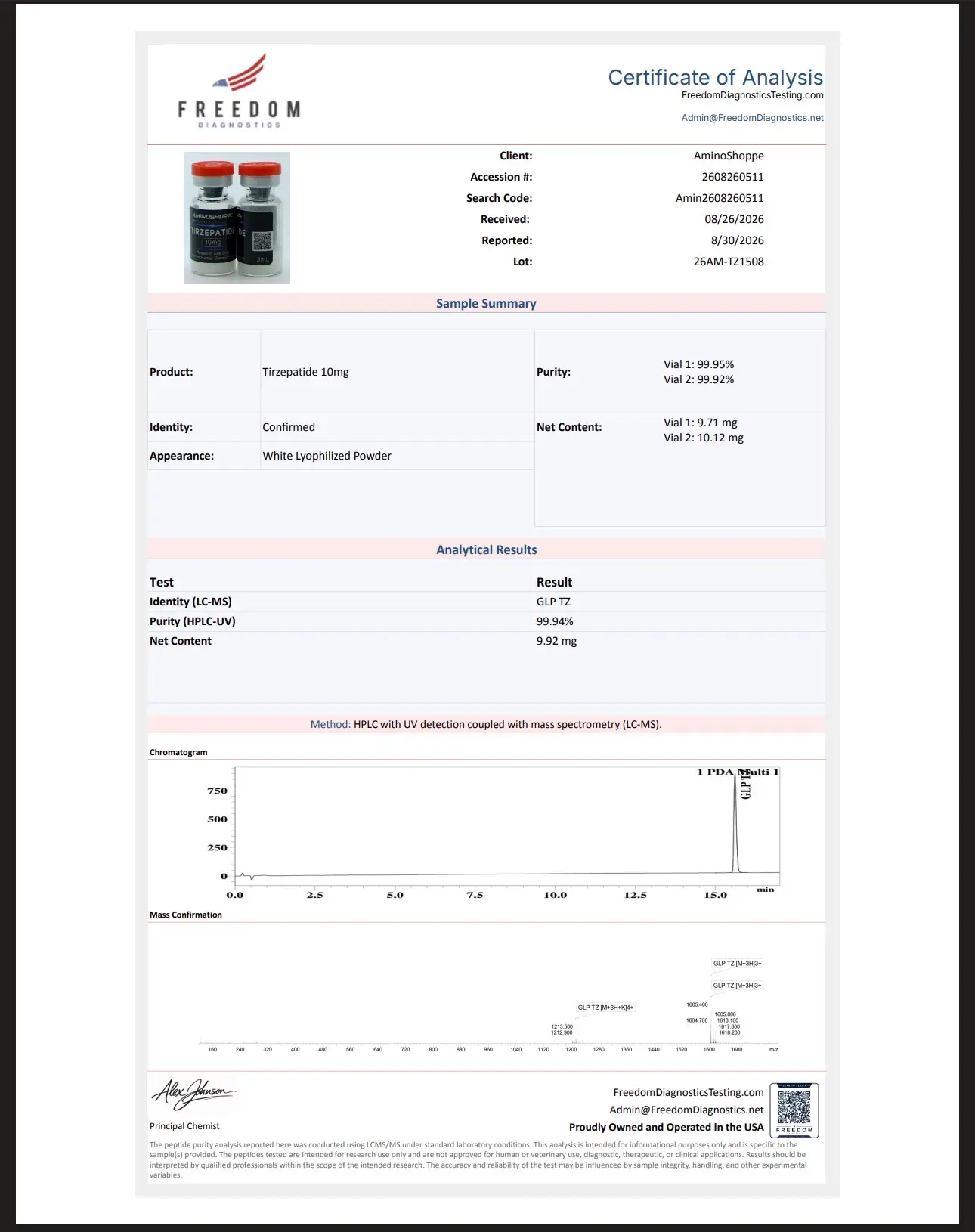
A certificate of analysis, commonly called a COA, is one of the strongest quality signals available on a peptide listing. It is also one of the most frequently misunderstood. The presence of a document is useful only when the document can be connected to the material being offered.
Review whether the COA identifies the compound and includes a lot or batch number. That lot number should correspond to the item or production lot available for purchase whenever the supplier’s process allows for lot-specific documentation. A generic sample report may demonstrate the type of testing a supplier performs, but it is not the same as evidence for a specific lot.
The report should state the testing performed and provide a result. For peptide materials, analytical methods may include high-performance liquid chromatography and mass spectrometry. HPLC can support a stated purity result under defined test conditions, while mass spectrometry can support molecular identity. Neither should be reduced to a decorative badge. The method, result, sample identification, and report context matter.
A reported purity percentage should be read carefully. It is not a blanket statement about every quality attribute of a material, and it does not replace identity confirmation, storage controls, packaging review, or lot traceability. It is one analytical result within a broader quality review.
Questions to Ask When Reading a COA
Check whether the document identifies the analyte, lot or batch, test date, method, result, and reporting laboratory or responsible party. Also look for obvious mismatches between the listing and report, such as a different compound name, concentration, vial size, or lot designation.
If the document is difficult to read, missing critical identifiers, or appears unrelated to the product listing, request clarification before purchase. A supplier should be able to explain whether a COA is lot-specific, representative, or pending release without making unsupported claims.
Review Testing Claims With Precision
“Lab tested” is a useful starting point, but it is not a complete specification. A credible listing or testing section should indicate what was tested, by whom, and what result was obtained. U.S.-based testing may be relevant to a buyer’s supplier-evaluation process, but the meaningful question remains whether the documentation is clear, applicable, and consistent with the specific product.
Do not assume that a purity result confirms sterility, endotoxin status, stability over time, or suitability for any particular procedure. Those are separate attributes that require separate testing and appropriate documentation. If a research protocol or internal quality system requires a defined attribute, verify that it is expressly supported rather than inferred from a general laboratory-test statement.
The appropriate level of documentation depends on the intended research context. A small independent research purchase may require a different review process than a university laboratory or regulated organization. In either case, the listing should provide enough information for the buyer to identify what is known, what is not stated, and what must be confirmed before ordering.
Check Presentation, Packaging, and Storage Details
A product page should state how the material is presented, such as a lyophilized vial or another defined format. Review the listed net content and confirm whether any accessory material is included or sold separately. Do not assume that a separate item, including bacteriostatic water or laboratory consumables, is included with a peptide unless the listing explicitly says so.
Storage and handling information should be concise but specific. Where provided, follow the supplier’s stated storage conditions, packaging directions, and inspection guidance. Upon receipt, document the package condition, product label, lot number, and any temperature-control materials relevant to the shipment. Report discrepancies before opening or using the material in a research workflow.
It is reasonable to expect limits in listing-level information. A product page cannot replace a laboratory’s own receipt inspection, inventory controls, chain-of-custody procedures, or method-specific qualification. It should, however, provide a reliable starting record for those processes.
Compare Price Only After Comparing Specifications
Price comparisons can be misleading when vial amount, stated purity, documentation access, and lot traceability differ. A lower listed price may reflect a smaller quantity, a different form, limited testing information, or fewer supplier controls. Compare like for like: the same named material, presentation, stated net content, and available analytical support.
Availability also affects purchase planning. If a project depends on consistent material across multiple stages, review whether the supplier indicates inventory status, variant availability, and the process for accessing associated test records. Do not build a research schedule around assumed restock timing or assumed lot continuity.
AMINOSHOPPE product listings are structured around research-use restrictions, product identification, and available laboratory-testing information. Buyers should still complete their own documentation review for the exact item and lot selected.
Assess the Supplier Record Beyond the Product Page
A single strong listing is helpful, but supplier practices should be consistent across the catalog. Review whether research-only language, policy statements, contact channels, testing references, and product descriptions follow a coherent standard. Repeated inconsistencies can make it difficult to determine which claims apply to a particular purchase.
Clear purchasing terms, transparent fulfillment information, and a defined process for documentation questions are practical trust signals. So is restraint. Suppliers should communicate material facts without presenting research compounds as consumer wellness products or implying unapproved uses.
Before submitting an order, retain a copy of the listing details and relevant COA for your procurement file when appropriate. Product pages, inventory, and lot availability can change. Keeping the record tied to the purchase date helps preserve the context of the sourcing decision.
A Disciplined Review Produces Better Purchase Records
The best peptide listing is not the one with the most promotional language. It is the one that lets a qualified buyer verify identity, understand the research-only limitation, review applicable analytical documentation, and make a purchase decision without filling critical gaps with assumptions.
When a listing leaves uncertainty, pause the transaction and request the missing detail. A controlled purchasing process starts before checkout, with documentation that can stand on its own in a research record.
Related Posts


Top Compounds for Mitochondrial Research
Mitochondrial studies can produce misleading results when a test article…

Practical Guide to Peptide Compliance Labeling
A vial label has a narrow but consequential job: identify…