A peptide listed as a dry vial and the same peptide listed in solution should not be treated as interchangeable inventory. In lyophilized versus liquid peptides, the practical distinction is not merely convenience. It affects stability assumptions, receiving procedures, storage controls, recordkeeping, and the confidence a researcher can place in the material’s stated condition at the time of use.
For qualified laboratory and research buyers, the correct format depends on the compound, the study timeline, available storage infrastructure, and the supplier’s supporting documentation. Both formats can have legitimate research applications. The relevant question is whether the presentation, packaging, and quality records fit the intended research workflow.
All peptide materials should be handled only by qualified personnel in an appropriate research setting. Products sold for research use are not for human or animal consumption.
What Lyophilized Peptides Are
Lyophilization, commonly called freeze-drying, removes water from a material under controlled low-temperature and vacuum conditions. The resulting peptide is typically supplied as a dry cake, powder, or thin film in a sealed vial. It may be visibly uniform or appear as a fragile porous mass, depending on the formulation and fill process.
The purpose of lyophilization is generally to reduce water-driven degradation pathways during storage and transport. Many peptides are more stable in dry form than in solution, particularly when solution-phase exposure could promote hydrolysis, oxidation, aggregation, deamidation, or other changes. That does not mean every lyophilized peptide has the same stability profile. Peptide sequence, excipients, residual moisture, container closure, headspace conditions, and storage temperature all matter.
A dry presentation also gives research teams greater control over when a solution is prepared. This can be useful when a study requires a fresh working preparation at a defined point in the workflow rather than a material that has already spent time in a solvent.
What Liquid Peptides Are
Liquid peptides are supplied as a prepared solution in a stated solvent or buffer system. Depending on the product, that solution may be a concentrated stock, a research-ready formulation, or a material prepared for a narrow storage and handling window.
The primary advantage is operational: the material is already in solution, reducing preparation steps before an experiment. For laboratories working under time constraints or managing standardized repeat procedures, that can simplify receiving and inventory use. However, a liquid format also introduces variables that must be documented clearly, including solvent identity, concentration, pH where relevant, fill volume, storage condition, and date-related stability information.
A liquid vial should never be assumed to contain only peptide and water. The formulation may contain a specific diluent, buffer, preservative, stabilizer, or other component. Those details can affect compatibility with an assay, instrument, analytical method, or downstream matrix. Researchers should evaluate the full product description and available documentation before assigning a liquid material to a study.
Lyophilized Versus Liquid Peptides: The Core Trade-Off
The central trade-off is control versus convenience. Lyophilized material commonly offers advantages for long-term inventory management because it limits the period during which the peptide remains dissolved. Liquid material can reduce preparation time and may support more consistent use when the supplied concentration and solvent are compatible with the method.
Neither format is automatically superior. A lyophilized peptide is not inherently stable under every condition, and a liquid peptide is not automatically unsuitable for storage. Valid decisions require product-specific information rather than assumptions based on format alone.
For example, a short-duration analytical project may prioritize a liquid reference material if the concentration, solvent, and documented stability align with the method. A research group acquiring material for future studies may prefer lyophilized vials because dry inventory can offer more flexibility before solution preparation. The compound itself remains the deciding factor. Some sequences and formulations are particularly sensitive to moisture, repeated temperature changes, light exposure, or contact with certain surfaces.
Stability Depends on More Than Format
Format is one stability variable, not a complete stability claim. Researchers should distinguish between the expected stability of an unopened product and the stability of a material after the container is first accessed or the peptide is placed into solution.
For lyophilized products, critical considerations include the vial seal, storage temperature, moisture exposure, and whether the material has been subjected to damaging temperature excursions during shipping or storage. A compromised closure can undermine the purpose of the dry presentation. Visual inspection may identify obvious container damage, but it does not replace analytical verification.
For liquid products, degradation risk can be influenced by solvent composition, oxygen exposure, light, pH, concentration, and the amount of time the solution remains outside its recommended storage range. A liquid material may also be more vulnerable to changes introduced by repeated vial access. Where a study requires high confidence in identity or concentration, appropriate analytical controls should be considered within the laboratory’s established quality system.
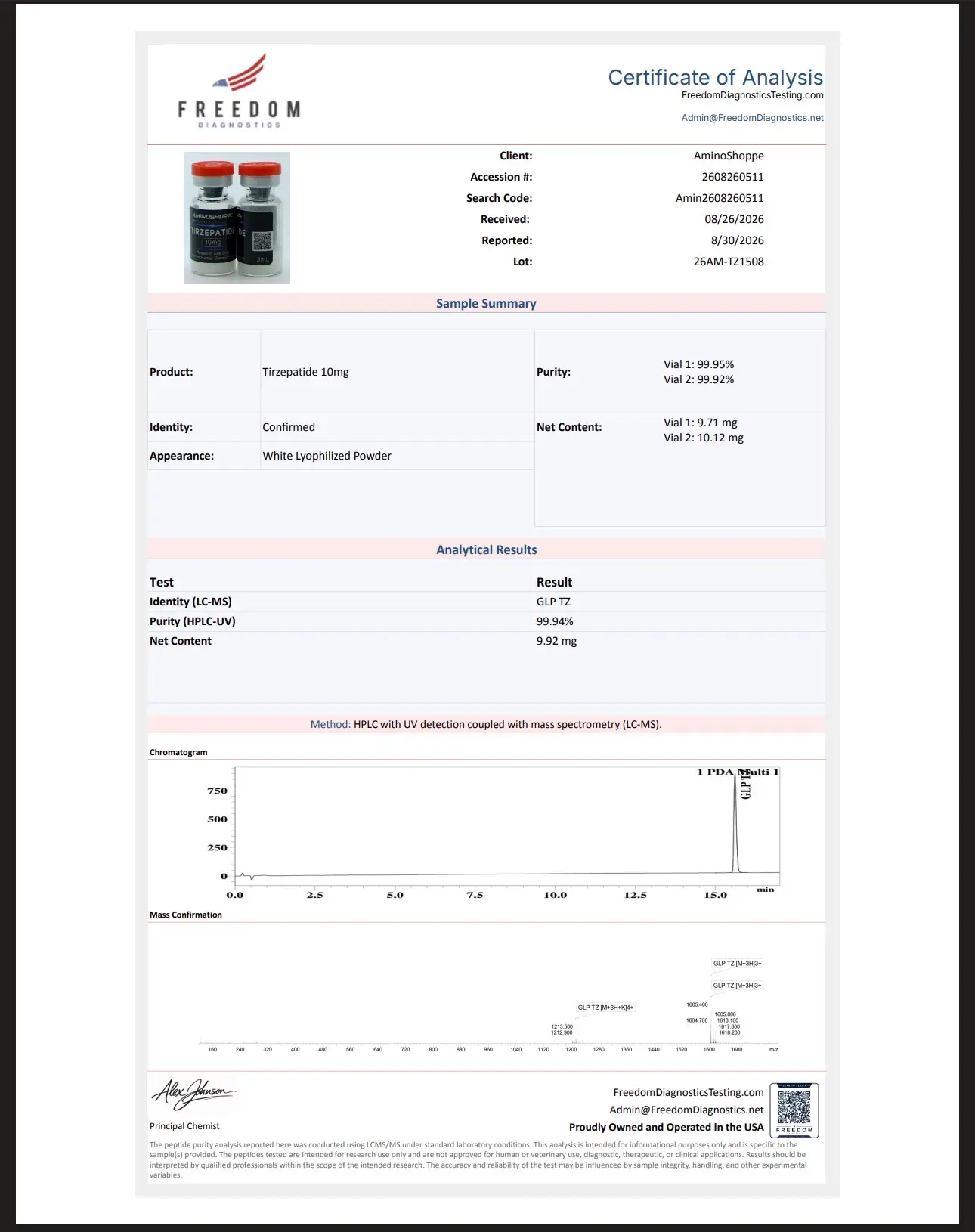
The supplied certificate of analysis is valuable, but it should be interpreted correctly. A COA documents the tested lot and reported test results under stated methods and conditions. It does not establish how a material was handled after receipt, nor does it replace the buyer’s own receiving, storage, and chain-of-custody procedures.
Storage and Shipping Considerations
A properly designed peptide supply chain begins before the package reaches the laboratory. The selected format should match the anticipated transit conditions, receiving schedule, and storage capacity at the destination.
Lyophilized peptides are often selected when shipping resilience and longer inventory horizons are priorities. Dry material may be less sensitive than a pre-made solution to certain shipping stresses, but it can still be affected by heat, moisture, and extended delays. Packaging, insulation, temperature controls, and the supplier’s handling specifications remain relevant.
Liquid peptides may require tighter attention to shipping and receipt because their solvent system can make temperature control more consequential. A laboratory receiving liquid materials should have a defined process for prompt inspection, documented receipt, and placement into the stated storage condition. Delays at a loading dock or unattended delivery location can create avoidable uncertainty.
In either case, do not rely on a general storage rule copied from another peptide. Storage requirements should be evaluated from the product-specific label, lot documentation, and supplier-provided specifications. A similar-looking vial or closely related sequence may have different requirements.
Documentation That Supports Better Purchasing Decisions
Research procurement should assess more than the format label. A credible product record identifies the compound, lot or batch, stated quantity or concentration, and relevant analytical information. For liquid products, solvent and concentration details are especially important. For lyophilized products, the stated net content, presentation, and recommended storage conditions should be clear.
When comparing suppliers, documentation quality can reveal whether a product is being represented with appropriate technical discipline. Look for lot-linked certificates of analysis, defined testing methods where supplied, clear research-use-only language, and consistent naming across the listing, vial label, and documentation. Ambiguous concentrations, missing solvent information, or generic certificates that cannot be associated with a lot create unnecessary procurement risk.
At AMINOSHOPPE, research buyers should evaluate available lab-test documentation alongside the product listing and label information. Documentation supports purchasing decisions, but qualified researchers remain responsible for confirming that a material is suitable for their protocol and institutional requirements.
Practical Selection Criteria for Research Buyers
Before choosing a format, establish what the study actually requires. Start with the intended use window: material needed immediately for a defined analytical run may favor a documented liquid solution, while material intended for staged work may favor a dry presentation. Next, consider whether the proposed solvent system is compatible with the assay and whether the laboratory can maintain the required storage conditions without interruption.
Also consider the scale of the work. A small study with limited consumption may create different inventory concerns than a recurring program using the same material across multiple scheduled runs. The objective is not to select the most convenient vial in isolation. It is to select a format that reduces avoidable variables in the complete workflow, from purchase order through final data review.
For materials supporting sensitive or quantitative work, retain lot documentation with study records and document receipt condition, storage location, and material use according to laboratory procedure. Those controls help distinguish a supplier-provided test result from the handling history created within the research environment.
A well-chosen peptide format should make the research process more controlled, not merely faster. When the product presentation, storage plan, documentation, and method requirements align, the format becomes one less source of uncertainty in the work that follows.
Related Posts

A Laboratory Guide to Peptide Solubility
A peptide that appears simple on paper can become a…

NAD Plus Research Uses in Cellular Metabolism
NAD+ is not simply a metabolic cofactor listed on a…

Practical Guide to Peptide Compliance Labeling
A vial label has a narrow but consequential job: identify…