NAD+ is not simply a metabolic cofactor listed on a pathway diagram. In laboratory settings, its concentration, redox state, compartmentalization, and turnover can materially affect how investigators interpret cellular energy data, stress responses, and enzyme activity. NAD plus research uses therefore extend across fundamental metabolism, molecular biology, aging-model research, and assay development. All NAD+ materials discussed here are intended for qualified laboratory research only, not for human or animal consumption.
NAD Plus Research Uses: The Core Rationale
Nicotinamide adenine dinucleotide, commonly written as NAD+, is a ubiquitous coenzyme involved in electron transfer and substrate-dependent enzyme activity. Its oxidized form, NAD+, and reduced form, NADH, operate as a redox pair. This relationship makes the NAD+/NADH balance a useful research variable when studying cellular energetic state, mitochondrial function, and metabolic adaptation.
Researchers may examine total NAD pools, NAD+/NADH ratios, or changes in NAD availability under controlled conditions. Those measurements are not interchangeable. A stable total NAD pool can coexist with a meaningful change in the NAD+/NADH ratio, while bulk-cell measurements may not reflect differences between cytosolic, nuclear, and mitochondrial compartments. Experimental claims should match the resolution of the assay being used.
NAD+ also serves as a substrate for enzyme families that consume it during signaling or repair-associated activity. For that reason, a change in NAD+ status may reflect more than energy metabolism. It can also indicate altered demand from NAD-consuming enzymes, changes in precursor salvage activity, or stress-related shifts in cellular homeostasis.
Cellular Redox and Energy Metabolism Studies
One of the most established research uses for NAD+ is the evaluation of oxidation-reduction reactions. NAD+-dependent dehydrogenases participate in glycolysis, tricarboxylic acid cycle activity, fatty-acid metabolism, and related pathways. In cell-based or biochemical systems, researchers can use NAD+ as a defined cofactor when characterizing enzyme kinetics, substrate conversion, or metabolic pathway behavior.
Mitochondrial research is a frequent application. Because oxidative metabolism depends on regulated electron flow, investigators may assess how cellular stressors, nutrient conditions, genetic modifications, or candidate compounds affect NAD-linked metabolic outputs. Common readouts include NAD+/NADH measurements, oxygen-consumption data, ATP-associated endpoints, and targeted metabolite panels.
Interpretation requires restraint. A higher measured NAD+ value does not independently establish improved mitochondrial performance, and an altered NAD+/NADH ratio does not identify a single causal pathway. Changes may result from extraction conditions, cell density, sample timing, media composition, or assay interference. Appropriate controls and orthogonal measurements are necessary when assigning biological meaning.
Enzyme and Cofactor Assay Development
Purified NAD+ is also relevant to analytical assay design. Research teams may use it as a reaction component, reference material, or calibration-related input in assays involving NAD-dependent enzymes. This can include spectrophotometric, fluorometric, luminescent, chromatographic, and mass-spectrometry workflows.
Assay design should account for the intended analyte and detection method. NAD+ and NADH have different optical and chemical properties, and sample preparation can change the apparent abundance of each form. A method optimized for total NAD may not be suitable for preserving a redox ratio. Researchers should establish linearity, recovery, matrix effects, precision, and stability within their own system rather than relying on a single published workflow.
DNA Damage Response and PARP Research
NAD+ is consumed by poly(ADP-ribose) polymerases, commonly called PARPs. These enzymes are central to research on DNA damage signaling, chromatin regulation, and cellular stress response. When PARP activity increases, cellular NAD+ demand can rise, creating a useful connection between DNA damage models and metabolic measurements.
In this area, NAD+ can be used in biochemical studies of enzyme activity or in cell-based investigations that compare NAD-related endpoints before and after defined stress conditions. Researchers may evaluate PAR formation, DNA repair markers, viability measures, mitochondrial endpoints, and NAD pool changes together. No one marker should be treated as definitive on its own.
The trade-off is specificity. A decline in cellular NAD+ after a stress challenge may be consistent with increased PARP activity, but it can also be influenced by altered biosynthesis, degradation, cell loss, or broader metabolic dysfunction. PARP-focused conclusions require controls that distinguish enzyme-dependent effects from general toxicity or reduced cell number.
Sirtuin and Protein Regulation Research
Sirtuins are NAD+-dependent enzymes studied for their roles in protein deacetylation, metabolic regulation, inflammatory signaling, circadian biology, and cellular stress adaptation. NAD+ availability is relevant because sirtuin activity is linked to substrate availability, although activity in a biological system is shaped by much more than NAD+ concentration alone.
Research models may examine how nutrient state, oxidative stress, genetic perturbation, or pathway-specific interventions change NAD pools alongside sirtuin-associated markers. This work can help identify relationships between cofactor status and downstream protein regulation. It does not establish that adding or measuring NAD+ alone explains the observed phenotype.
Careful study design matters particularly in aging-related models, where multiple pathways change at once. Senescence markers, mitochondrial function, DNA damage signals, inflammatory mediators, and cell-cycle status may move in parallel. A controlled design with defined endpoints is more informative than broad claims based on a single biomarker.
Aging, Senescence, and Stress-Response Models
NAD+ is widely studied in models of age-associated cellular change because NAD metabolism can shift with replicative stress, inflammatory signaling, mitochondrial impairment, and DNA damage burden. Researchers may compare NAD-related metrics across early- and late-passage cells, stress-induced senescence models, or tissue-derived experimental systems.
This work is useful for hypothesis generation, especially when paired with direct measures of cell state. For example, a study may assess NAD+/NADH balance together with mitochondrial membrane potential, reactive oxygen species, senescence-associated markers, and metabolomic data. The strength of the conclusion depends on whether these endpoints align and whether the model is appropriate for the question being asked.
Aging research also presents a translation limit. Findings from isolated enzymes, cultured cells, or short-duration stress models should not be treated as evidence of clinical outcomes. Research-use-only materials are not approved drugs, dietary supplements, or products for diagnostic or therapeutic application.
Comparing NAD+ With Related Research Materials
NAD+ should not be treated as interchangeable with NAD precursors or NAD-related metabolites. Nicotinamide, nicotinamide riboside, nicotinamide mononucleotide, NADH, and other pathway components enter a study at different biochemical points. The appropriate material depends on whether the objective is direct cofactor use, pathway tracing, salvage-pathway analysis, enzyme characterization, or comparative metabolism.
Direct NAD+ may be suitable when a defined cofactor is required in a cell-free enzyme system or when a study is designed to evaluate NAD+ itself as an analytical or experimental variable. A precursor may be more relevant when the research question concerns intracellular biosynthesis or salvage-pathway capacity. These distinctions affect controls, timing, endpoint selection, and how results can be interpreted.
Material Selection and Documentation Considerations
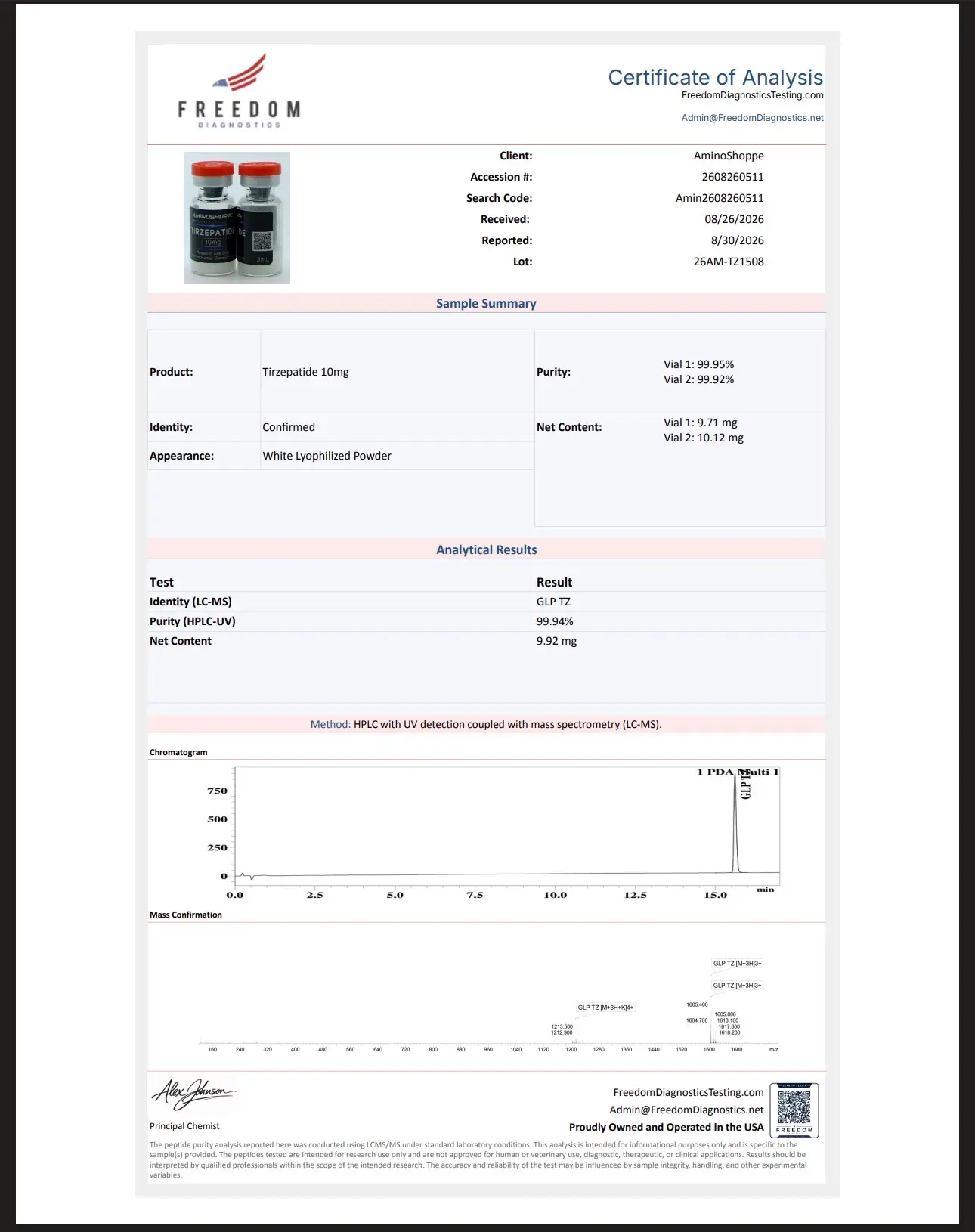
For laboratory purchasing, identity and documentation should be evaluated before a material enters a workflow. A certificate of analysis can provide relevant lot-specific information such as reported purity, identity testing, and analytical methods. It should be reviewed alongside product labeling, storage specifications, lot traceability, and the requirements of the intended assay.
Quality documentation supports procurement decisions, but it does not replace incoming-material procedures or method validation. Laboratories should determine whether the material is compatible with their analytical platform, reference standards, and internal acceptance criteria. For sensitive metabolic experiments, lot-to-lot consistency and documented handling are particularly relevant because minor variations can complicate comparisons across study runs.
Researchers should also confirm that packaging, labeling, and records clearly maintain the research-use-only status of the material. NAD+ research materials must be handled by qualified personnel in accordance with institutional policies, applicable regulations, and laboratory safety procedures. They are not for human or veterinary administration, food use, or household use.
A useful NAD+ study begins with a narrow question: is the team measuring redox balance, testing an NAD-dependent enzyme, examining a stress-response pathway, or validating an analytical method? Selecting the material, controls, and documentation around that question produces data that are more defensible than broad claims built around a single cofactor measurement.
Related Posts

Top Signs of Peptide Quality for Research
A peptide vial can look professionally labeled and still leave…

Bacteriostatic Water Review for Research Buyers
A bacteriostatic water review should begin with a basic procurement…

Best Peptide Sourcing Criteria for Research
A peptide vial is only as credible as the evidence…