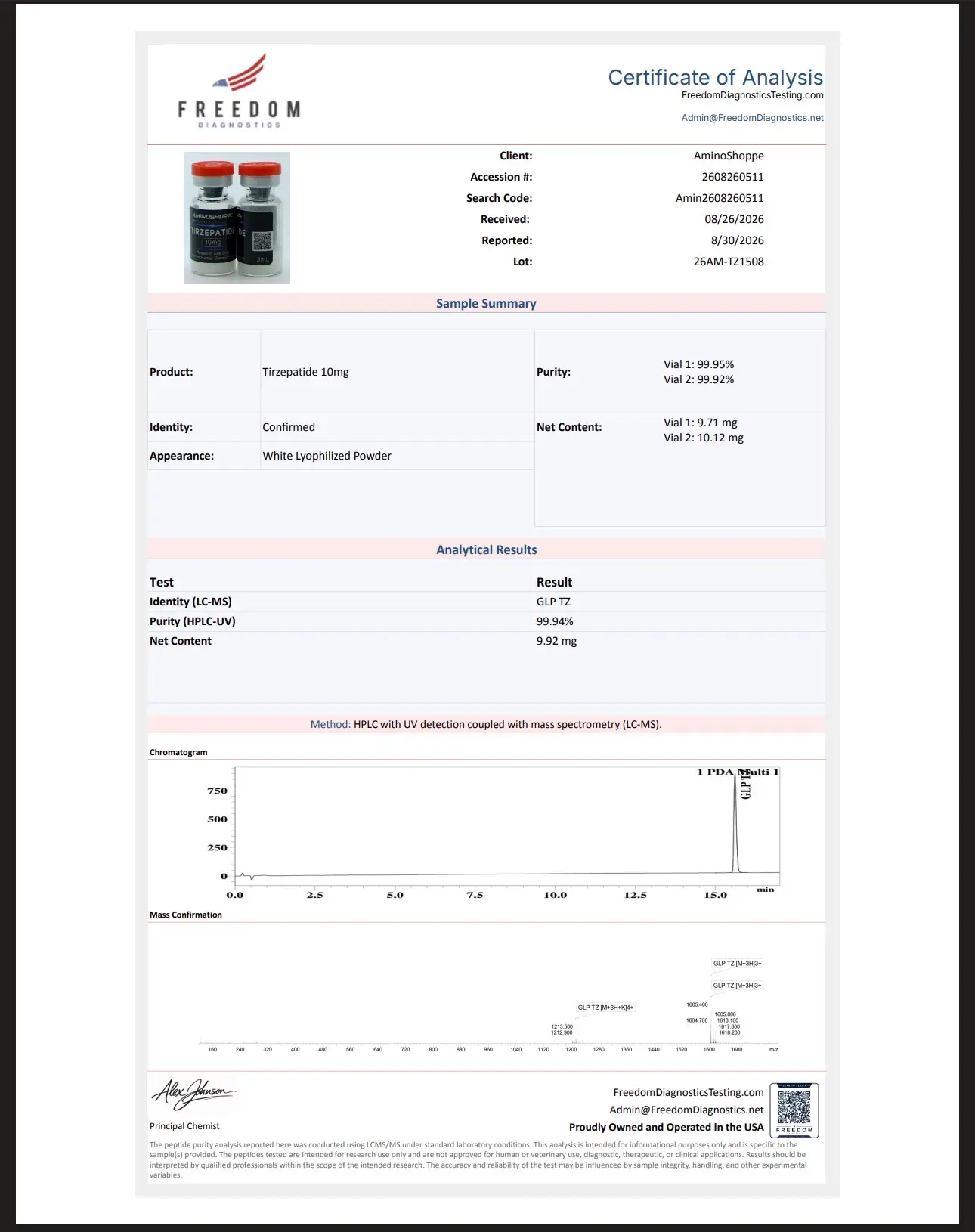
A product page marked “US lab tested” is making a quality-control claim, not granting approval for any medical, diagnostic, human, or veterinary use. For research buyers, the practical question is not simply what does US lab tested mean, but what was tested, by whom, against which specification, and whether the documentation applies to the exact lot being purchased.
For research-use-only peptides, mitochondrial compounds, and related laboratory materials, testing documentation can help support procurement decisions. It does not replace a laboratory’s own qualification procedures, method validation, storage controls, or compliance review.
What Does US Lab Tested Mean?
In its most useful sense, US lab tested means a product sample was analyzed by a laboratory located in the United States. The analysis may assess one or more characteristics, such as identity, purity, concentration, moisture content, residual solvents, microbial status, endotoxins, or heavy metals.
The phrase alone does not define the method, the laboratory’s accreditation status, the acceptance criteria, or the breadth of the test panel. It also does not automatically mean every vial in inventory was individually tested. Many suppliers test a representative sample from a manufacturing lot, then associate the resulting documentation with that lot.
That distinction matters. A credible quality claim should be supported by records that allow a buyer to connect the tested material to the material received. For a research purchaser, “US lab tested” is best treated as the beginning of due diligence, not the final answer.
The Certificate of Analysis Is the Supporting Record
A certificate of analysis, commonly called a COA, is the document that gives a lab-testing claim operational value. A useful COA identifies the material clearly and records the analytical result in a format a technically informed buyer can review.
At minimum, look for the compound name, lot or batch number, test date, result, and stated specification. The report should also identify the analytical method where applicable. For peptides and similar research compounds, high-performance liquid chromatography, or HPLC, is commonly used to assess chromatographic purity. Mass spectrometry may be used to support molecular identity.
A purity percentage without context has limits. A reported result of 99% may indicate a strong chromatographic result, but it does not by itself answer every quality question. It does not necessarily establish peptide content by mass, sterility, endotoxin level, residual solvent profile, or suitability for a particular experimental protocol. The appropriate test package depends on the material and intended research application.
A COA should also be legible and internally consistent. Check that the compound name, unit of measure, lot number, and reported result do not conflict. Documentation that omits the lot number, uses a generic product label, or provides no analytical detail may be less useful for traceability.
Lot Matching Is Not Optional
The most relevant test record is one that matches the lot supplied. If a supplier displays a COA for a prior batch while shipping a different batch, the document may demonstrate a general testing practice but not the quality attributes of the received material.
Research buyers should compare the lot number on the product label, packaging, or accompanying documentation against the lot number on the COA. If the lot is not visible at the time of ordering, establish how lot-specific records are made available before material is introduced into a study.
This step is especially relevant when maintaining internal inventory records, managing repeatability across experiments, or purchasing materials for a small laboratory with formal receiving procedures.
A US Location Does Not Define Test Quality by Itself
Testing performed in the United States can be a meaningful signal of accessibility, documentation, and accountability. A domestic lab may make it easier to identify the testing facility, clarify a report, or obtain updated lot documentation. However, the physical location of the lab is not a substitute for sound analytical practice.
The quality of a test result depends on factors including sample handling, chain of custody, method suitability, calibration, analyst controls, reporting practices, and the laboratory’s quality system. Some buyers may require testing from a laboratory operating under specific accreditation or quality standards. Others may need only lot-specific identity and purity data for non-regulated exploratory work.
The right standard depends on the research environment. A private investigator running early-stage bench research has different documentation needs than an institution with established procurement controls. Neither should assume that a broad marketing phrase answers every qualification requirement.
What to Review Before You Purchase
A careful review starts with the product identity. Confirm that the material name, quantity, format, and stated research designation align with your protocol. Similar compound names can refer to different salts, sequences, concentrations, or formulations, and those differences can affect experimental planning.
Next, review available test documentation for the specific attributes that matter to your work. For a lyophilized peptide, identity and purity may be central. For a material used in an assay sensitive to contamination, additional testing may be relevant. For solvents, diluents, or bacteriostatic water, packaging integrity, labeled composition, storage requirements, and lot traceability should be part of receiving review.
Then assess whether the report is current and attributable. A document should indicate who performed the analysis, when it was performed, and which lot was tested. If a report uses terminology you do not recognize, do not infer more than it states. “Purity by HPLC” is not the same claim as “sterile,” and “identity confirmed” is not the same as a full impurity characterization.
Finally, preserve records. Retain the COA, order confirmation, lot information, receipt date, and storage notes with your internal research files. This supports repeatability and helps distinguish supplier-related variables from protocol-related variables if results differ between runs.
Common Misinterpretations of “Lab Tested”
The phrase can create false certainty when it is read too broadly. Lab tested does not mean a material is approved by the FDA. It does not mean it is manufactured under pharmaceutical GMP requirements. It does not mean it is intended for injection, ingestion, treatment, diagnosis, or use in humans or animals.
It also does not guarantee that a compound will perform identically in every research system. Analytical quality is one part of experimental control. Reconstitution procedures, storage temperature, freeze-thaw exposure, assay conditions, equipment calibration, and operator technique can all affect results.
A second misconception is that a higher reported purity percentage always means a better choice for every use case. Purity is relevant, but the meaningful question is whether the reported method and specification address the risks relevant to the study. A buyer evaluating a sensitive cell-based assay may reasonably need information beyond a single purity result.
Documentation Supports Better Research Decisions
For research-use-only materials, transparent testing is valuable because it provides a basis for evaluation rather than requiring buyers to rely solely on a product title or marketing claim. The strongest supplier documentation is specific: it identifies the material, the lot, the test method, and the reported result without overstating what the analysis proves.
AMINOSHOPPE positions its research materials with laboratory verification and research-only handling boundaries in mind. Buyers remain responsible for determining whether available documentation meets their institution’s policies, protocol requirements, and intended laboratory application.
When evaluating any US lab tested claim, request enough detail to make a controlled purchasing decision. A clear, lot-matched COA and a well-defined testing scope will tell you far more than the label alone, and they give your research process a stronger starting point.
Related Posts

Practical Guide to Peptide Compliance Labeling
A vial label has a narrow but consequential job: identify…

Best Peptide Sourcing Criteria for Research
A peptide vial is only as credible as the evidence…

How to Order Peptides Responsibly for Research
A peptide listing can look straightforward: compound name, vial size,…