A vial label and a stated purity percentage do not, by themselves, establish whether a material is suitable for a research workflow. Peptide quality control is the documented process used to assess whether a supplied peptide matches its stated identity, meets an applicable purity specification, and is represented accurately for laboratory research use.
For research buyers, the practical question is not whether a supplier makes broad quality claims. It is whether the available records, analytical methods, lot information, and handling controls support a defensible purchasing decision. This distinction matters when ordering specialized materials for method development, assay work, stability studies, or other non-clinical research applications.
What Peptide Quality Control Is Designed to Confirm
Peptide quality control begins with a defined specification. At minimum, that specification should identify the compound, expected molecular mass, stated purity target, quantity or content claim, lot identifier, and the analytical methods used for evaluation. The supplier then compares test results against that specification before the material is released for sale or use.
A meaningful review separates several questions that are often treated as one:
- Is the material the intended peptide or compound?
- Is the material sufficiently pure for the stated research purpose?
- Does the vial contain the represented amount of material?
- Can the result be traced to a specific production or test lot?
These are related but not interchangeable. A material can show the expected molecular mass while also containing process-related impurities. A high chromatographic purity result does not automatically establish accurate net peptide content. Documentation should make clear what was tested, how it was tested, and which lot the result applies to.
Identity Testing: Confirming the Expected Compound
Identity testing addresses whether the primary analyte is consistent with the named material. For peptides, mass spectrometry is commonly used because it can confirm an observed molecular mass against the expected mass. Depending on the molecule and research application, additional characterization may be appropriate.
Mass confirmation should be interpreted in context. It supports identity, but it is not a complete characterization package. Peptides may include closely related deletion sequences, oxidation products, truncated species, residual synthesis byproducts, or counterion-related mass considerations. The appropriate level of characterization depends on peptide length, sequence complexity, intended analytical use, and the claimed specification.
For buyers, the useful documentation point is straightforward: identity evidence should correspond to the product and lot being offered. A generic spectrum without product or lot traceability provides less purchasing value than a controlled record tied to a defined batch.
Naming and Salt Forms Matter
Research materials should be evaluated under their full stated description. The same peptide sequence may be supplied with different salt forms or counterions, and those details can affect molecular-weight reporting, content calculations, storage considerations, and experimental preparation.
A certificate should distinguish between peptide purity, peptide content, and the material form when applicable. Without that distinction, a buyer may incorrectly assume that a purity percentage is equivalent to the amount of active peptide present in the vial.
Purity Testing: Looking Beyond a Single Percentage
High-performance liquid chromatography, often abbreviated as HPLC, is widely used to assess peptide purity. In a typical chromatographic analysis, the sample is separated into detectable components, allowing the main peak to be compared with secondary peaks under stated conditions.
A reported HPLC purity percentage can be useful, but it should not be read in isolation. The method type, detection wavelength, integration approach, and reporting convention affect what the number represents. UV-based area percentage, for example, is a common analytical measure, yet different compounds and impurities may not respond identically at the selected wavelength.
That does not make HPLC unsuitable. It means the reported result should be treated as method-specific evidence rather than a universal measure of every possible contaminant. A credible quality-control record identifies the analytical technique and gives a result that can be connected to the tested lot.
Purity requirements also depend on the research objective. Early-stage method work may require a different specification than a reference comparison, sensitive cell-based assay, or analytical validation exercise. Buyers should define the acceptance criteria required by their own protocol before selecting material solely on a headline purity figure.
Content, Quantity, and the Difference Between Them
Quantity claims require their own review. A vial described by a nominal mass may refer to total material placed into the container, while actual peptide content can be influenced by water, residual solvents, salts, and counterions. These factors are particularly relevant for hygroscopic materials and compounds supplied in salt form.
Content testing may involve an assay method, amino acid analysis, quantitative NMR, or another validated approach suitable for the material. The method selected should fit the stated claim. When a research protocol depends on accurate concentration preparation, buyers should understand whether the supplier’s documentation supports a nominal fill claim, a peptide-content claim, or both.
This is not a reason to assume a discrepancy. It is a reason to avoid conflating separate specifications. Clear records reduce uncertainty before a material enters a study.
Documentation That Supports a Defensible Purchase
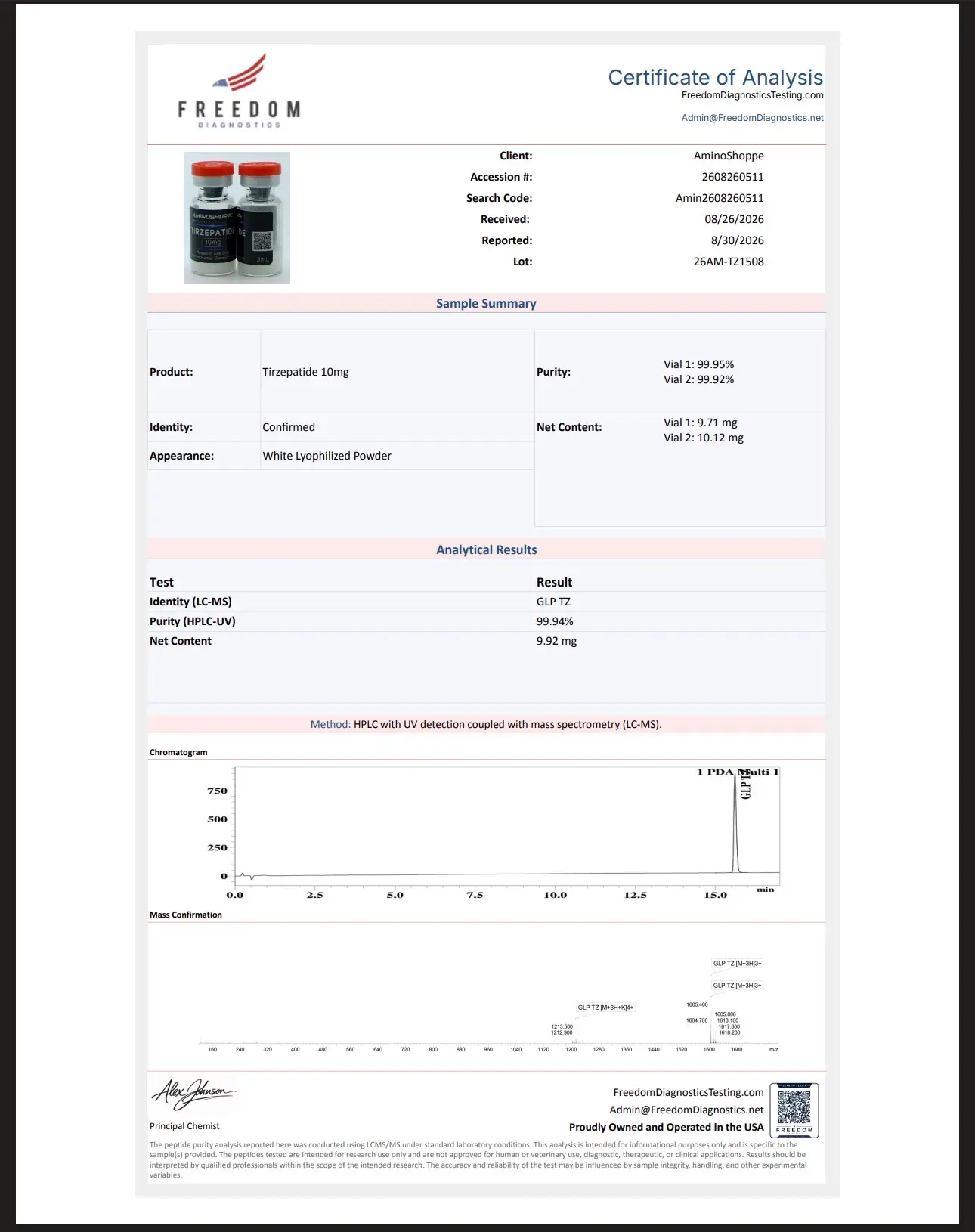
A certificate of analysis, or COA, is most useful when it functions as a traceable test record rather than a marketing attachment. It should identify the supplier or testing laboratory, product name, lot or batch number, test date, methods, specifications, results, and disposition or release status.
Third-party or U.S. laboratory testing can add confidence when the reporting is specific, current, and attributable to the supplied lot. However, the presence of a laboratory name alone is not enough. Buyers should review whether the document includes actual measured values and whether the batch number matches the product being purchased.
The strongest documentation is internally consistent. The product name on the listing, vial label, COA, and order record should align. If the material is described as a specific acetate, trifluoroacetate, or other form, the records should not switch terminology without explanation.
A Practical COA Review
Before placing an order, research buyers can review the COA for four practical controls: product identification, lot traceability, reported analytical result, and stated method. If any one of those elements is absent, the document may have limited value for internal records or later investigation.
It is also reasonable to ask whether the certificate is representative of the exact lot available for fulfillment. Testing a prior lot may demonstrate a supplier’s general process, but it does not replace documentation for the material being delivered.
Storage and Handling Are Part of Quality Control
Analytical release testing does not eliminate the need for controlled handling after purchase. Peptide stability can be affected by temperature exposure, repeated opening, moisture, light, oxygen, solution pH, and freeze-thaw cycles. The degree of sensitivity varies by sequence, formulation, and storage state.
Research teams should record receipt condition, lot number, date received, storage location, and any reconstitution or aliquoting steps required by their internal procedures. This preserves traceability if an unexpected assay result later requires investigation.
For dry materials, unnecessary exposure to ambient moisture should be avoided. For solutions, concentration, solvent compatibility, container selection, and storage duration should be evaluated under the laboratory’s own research protocol. Supplier documentation can inform these decisions, but it does not replace method-specific stability work.
Quality Claims Should Match the Intended Use
A reliable supplier should state the boundaries of its materials clearly. Research-use-only products are intended for laboratory, analytical, and investigational purposes only. They are not approved for human or animal consumption, therapeutic use, diagnosis, or administration.
This compliance boundary is directly connected to quality communication. A supplier may provide analytical documentation for research materials without implying clinical suitability, pharmacological safety, sterility, endotoxin status, or fitness for any regulated use unless those attributes are specifically tested and documented. Buyers should not infer unlisted testing from a purity claim or a COA.
AMINOSHOPPE maintains a research-use-only purchasing framework and emphasizes documented laboratory testing to help qualified buyers assess product identity and consistency. The buyer remains responsible for confirming that the selected material, specification, storage condition, and documentation are appropriate for the planned research activity.
Quality control is most valuable when it remains specific: a named compound, a traceable lot, a stated method, an actual result, and a clear use boundary. That level of discipline gives research buyers a stronger basis for selecting materials and maintaining reliable records throughout the work that follows.
Related Posts

A Laboratory Guide to Peptide Solubility
A peptide that appears simple on paper can become a…

Lyophilized Versus Liquid Peptides: Key Differences
A peptide listed as a dry vial and the same…

Research Peptide Shipping Policies Explained
A research order is not complete when payment is submitted.…