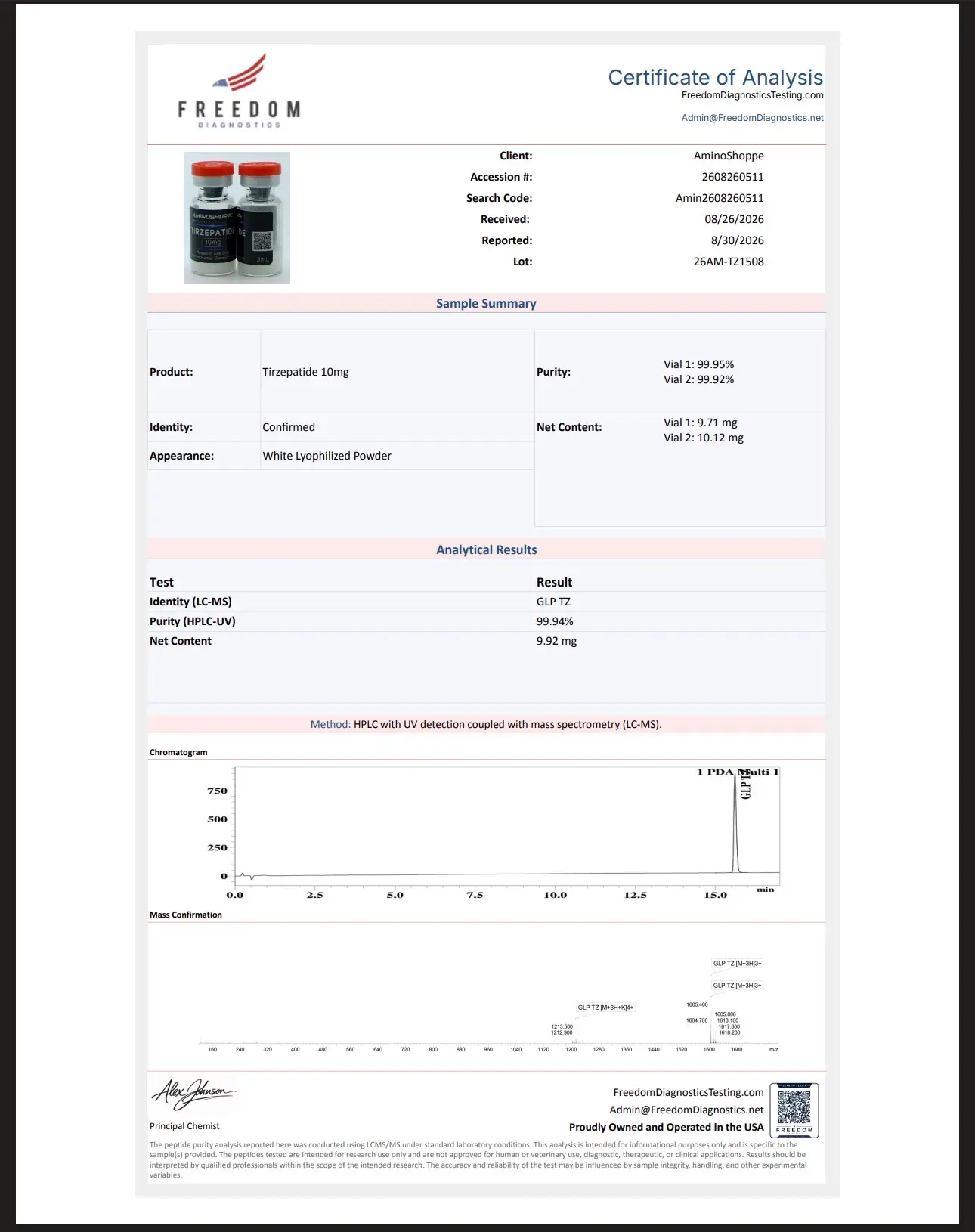
A retatrutide assay review should begin with a basic distinction: a reported assay result is not a blanket statement that a material is suitable for every research purpose. For a research-use-only peptide, the value of an assay lies in what it specifically measures, how it was measured, and whether the reported result is traceable to the exact lot under consideration.
Research buyers evaluating Retatrutide should treat analytical documentation as part of procurement, not as a marketing attachment. A certificate of analysis can support a purchasing decision when it identifies the tested lot, names the analytical methods used, reports clear acceptance results, and aligns with the material description and handling requirements. It cannot convert a research material into a product intended for human or animal consumption.
What a Retatrutide Assay Review Should Establish
Retatrutide is a complex peptide research compound. A meaningful review should address three separate questions: Is the material consistent with the stated identity? What level of purity or peptide content was measured? Does the documentation adequately describe the tested sample and method?
These questions are related but not interchangeable. A mass-spectrometry result may support molecular identity, while an HPLC chromatogram may indicate chromatographic purity. A quantitative assay may estimate peptide content relative to a reference standard. None of these results should be described as proof of biological activity, sterility, safety, or suitability for any use outside controlled laboratory research.
The strongest documentation is lot-specific. The lot number on the certificate should match the lot number on the product label or accompanying records. A generic certificate without a matching identifier may describe a representative material rather than the actual material received. That difference matters when a project requires reproducible inputs and defensible recordkeeping.
Assay, Identity, and Purity Are Different Measurements
The word “assay” is often used loosely in peptide sourcing. In analytical practice, its meaning depends on the method and reporting convention. It may refer to the measured amount of a target analyte, the estimated active peptide content, or a percentage result relative to a defined standard. Research buyers should read the method description rather than assume that “assay” means purity.
Identity confirmation
For peptide materials, LC-MS is commonly used to evaluate whether the observed molecular mass is consistent with the expected compound. A useful report identifies the sample and provides an observed mass or charge-state pattern that corresponds with the calculated molecular mass. This supports identity assessment, but it does not fully characterize every potential impurity or establish concentration.
Identity information should also be consistent with the stated form of the material. Counterions, salts, residual solvents, and water content can affect how mass-based results are interpreted. A label showing a nominal vial quantity is not necessarily equivalent to the exact mass of peptide present unless the supplier defines the basis for that value.
Chromatographic purity
HPLC or UPLC testing is commonly used to estimate purity by separating the principal peptide peak from detectable related peaks. A high reported percentage can be relevant, but buyers should understand what the result represents. It is generally an area-percentage measurement under a stated chromatographic method, not a complete inventory of every possible contaminant.
Chromatographic purity also depends on method conditions. Detection wavelength, column chemistry, gradient, integration rules, and reporting thresholds can influence the final value. Two reports can show different purity percentages for the same general material if the methods differ. For that reason, a precise percentage without method context has limited procurement value.
Peptide content and quantitative assay
Purity and peptide content may diverge. A material can show a dominant chromatographic peak while still carrying moisture, residual counterion, or other non-peptide mass that affects the actual amount of peptide by weight. Where quantitative content matters to an experimental design, buyers should look for a clearly defined assay method, calibration approach, and result basis.
A report should make clear whether the result is expressed as area percent, mass percent, content relative to a standard, or another defined calculation. Ambiguous terms such as “99% tested” are not sufficient for a technical review unless the underlying method and unit are provided.
Documentation That Supports a Purchase Decision
A certificate of analysis is most useful when it can be reviewed as a controlled record rather than a generic product claim. At minimum, a research buyer should expect the document to identify the compound, lot or batch number, test date, and reported results. The laboratory or testing organization should be identifiable, and the methods should be named with enough specificity to explain what was evaluated.
Additional detail improves confidence. Chromatograms, mass spectra, sample identifiers, method references, and analyst or quality-authorization fields make it easier to determine whether the results apply to the supplied material. Documentation should also be internally consistent. The product name, lot number, sample description, quantity basis, and date fields should not conflict.
A lack of detail does not automatically establish that a material is deficient. It does, however, limit what can be concluded from the record. For exploratory work with low documentation requirements, a buyer may accept a narrower data package. For method development, comparative work, or projects requiring repeat procurement, traceable lot-level records are the more appropriate standard.
Questions to Apply to Any Retatrutide COA
Before accepting an assay result at face value, research buyers should determine whether the certificate answers the operational questions that affect their work. The most relevant checks are straightforward:
- Does the lot number on the certificate match the product lot?
- Is the method identified as LC-MS, HPLC, UPLC, or a defined quantitative assay?
- Does the report distinguish identity confirmation from purity and content?
- Are the units, specifications, and result basis stated clearly?
- Is the testing date reasonable for the material and supported by storage records?
- Does the supplier provide research-use-only handling boundaries?
These checks are more valuable than comparing a single percentage across sellers. A lower reported figure with a clear, lot-matched method package may be more actionable than a higher figure presented without sample traceability or method scope.
Storage and Handling Affect Analytical Relevance
An assay result applies to the sample at the time it was tested. It does not eliminate the need for controlled receipt, storage, and handling after purchase. Research operations should follow the supplier label, applicable standard operating procedures, and internal inventory controls. Record the received lot, date, storage location, and any preparation performed within the laboratory.
Repeated exposure to unsuitable conditions, poor container control, or unrecorded handling can compromise the value of initial quality documentation. If a study depends on a defined analytical input, retain the original certificate with the laboratory records and use internal controls appropriate to the research setting.
Research-use-only materials must remain within their stated use category. Retatrutide supplied for laboratory research is not approved or provided for human or veterinary administration, diagnosis, treatment, or consumption.
A Practical Standard for Research Procurement
The right level of review depends on the study. Early-stage analytical or non-clinical research may prioritize confirmed identity, stated purity, and clear lot traceability. More controlled work may require expanded analytical data, qualification testing on receipt, or comparison against an internal reference material. The appropriate standard is determined by the protocol, not by a single certificate percentage.
AMINOSHOPPE positions Retatrutide and related materials for laboratory research only, with quality verification and documentation as central procurement considerations. Buyers should retain all lot-specific records and evaluate assay data against their own research requirements before introducing any material into a workflow.
A disciplined retatrutide assay review does not ask whether a certificate looks impressive. It asks whether the record identifies the exact material, defines what was measured, and gives the research team enough information to make a controlled, documented decision.
Related Posts

SS-31 Mitochondrial Peptide Research Overview
A vial label alone is not sufficient documentation for mitochondrial…

Peptide Quality Control for Research Materials
A vial label and a stated purity percentage do not,…

Research Peptide Shipping Policies Explained
A research order is not complete when payment is submitted.…