A peptide labeled 99% pure may be appropriate for one research application and insufficient for another. The number alone does not establish identity, assay suitability, storage history, or whether the documentation applies to the vial in hand. Knowing how to verify peptide purity means reviewing the analytical evidence as a complete lot-specific quality record, then deciding whether that record supports the intended laboratory use.
All materials should be handled as research-use-only products. They are not intended for human or animal consumption, diagnostic use, or therapeutic use.
How to Verify Peptide Purity: Start With the Lot
Purity verification begins before a vial is opened. Request or review the certificate of analysis, commonly called a COA, for the exact lot number assigned to the material. A general product specification or sample report can describe a supplier’s typical standard, but it does not verify the composition of a specific production batch.
The lot number on the COA should match the lot number on the product label and any accompanying packaging documentation. If there is no lot number, no test date, or no clear connection between the report and the material received, the document has limited value as a quality-control record.
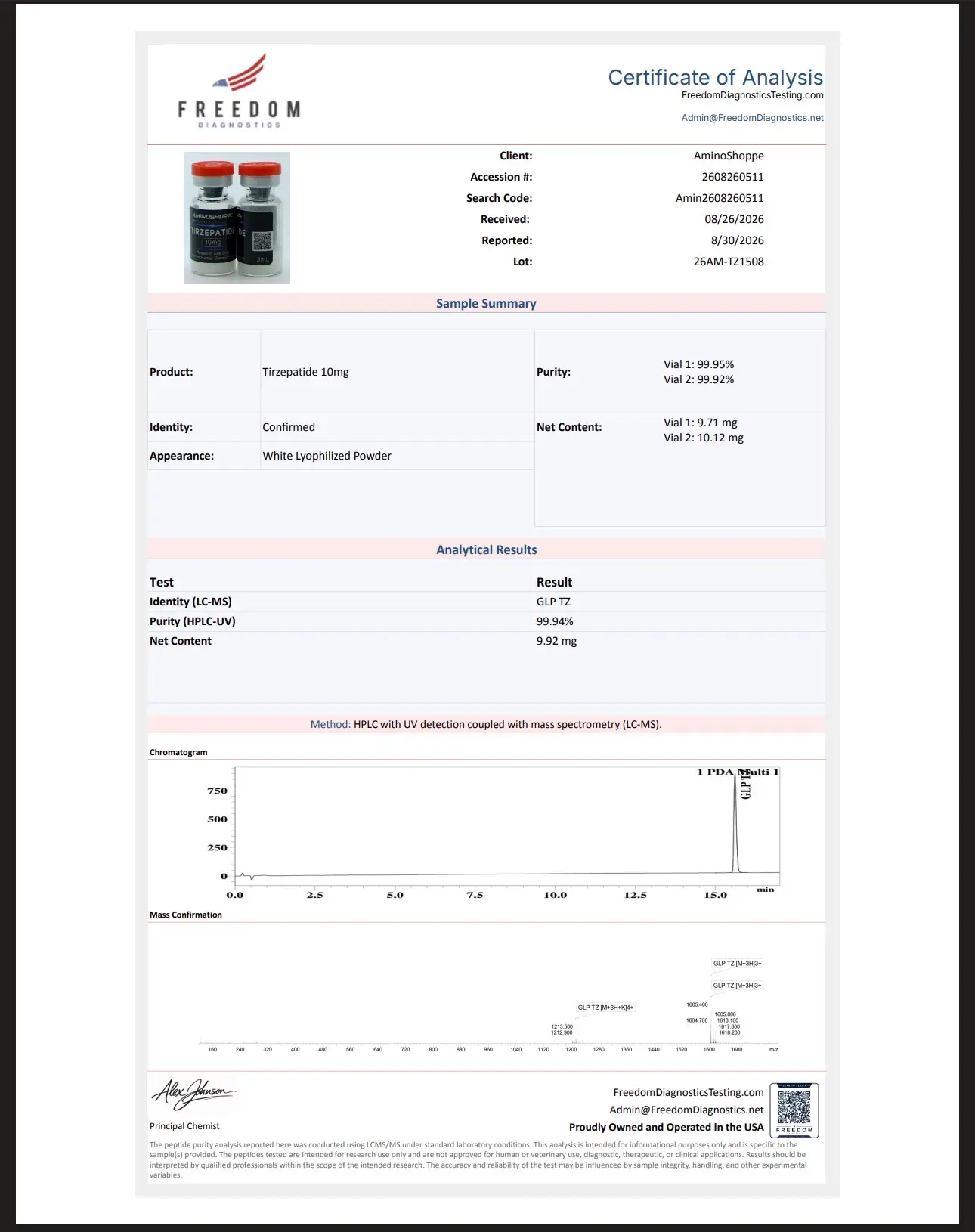
A credible COA should identify the analyte, lot or batch, reported purity, analytical method, testing date, and result. It should also identify the testing laboratory or responsible quality function. When a supplier states that a product has undergone U.S. laboratory testing, the associated record should make it possible to connect that claim to the specific material being evaluated.
Do not treat a COA as a marketing statement. Treat it as an analytical document. Look for the method used to generate each result, not only a pass/fail declaration. A purity percentage without a method, chromatogram, or identity result does not provide enough context for demanding research work.
Understand What the Purity Percentage Measures
For many synthetic peptides, reported purity is determined by high-performance liquid chromatography, or HPLC. The result is often expressed as chromatographic area percentage at a selected detection wavelength. If the main peak accounts for 98% or 99% of the measured area, that may support a high-purity designation under that method.
However, HPLC area purity is not the same as absolute peptide content. It does not automatically account for water, residual solvents, counterions such as trifluoroacetate or acetate, salts, or variations in ultraviolet response between the target peptide and an impurity. A vial may show high chromatographic purity while containing less active peptide mass per milligram than an assumption based on label weight would suggest.
This distinction matters when research depends on accurate molar calculations, comparative assay work, or reproducibility across lots. If peptide content is critical, ask whether the documentation includes assay testing, water content, residual solvent testing, counterion information, or another measurement relevant to the material’s supplied form.
The acceptable purity threshold depends on the study. Early analytical work may tolerate a lower specification if impurities are characterized and controlled. Sensitive cell-based assays, receptor studies, reference-standard work, or experiments intended for publication may require higher purity and more complete characterization. The correct question is not whether 98% or 99% is universally good. It is whether the stated method and impurity profile are suitable for the research objective.
Review the HPLC Chromatogram, Not Just the Result
An HPLC chromatogram provides more information than a single purity figure. The expected peptide should appear as the dominant peak, with minor peaks evaluated in relation to the reported area percentage. The chromatogram should be readable, labeled, and consistent with the COA’s stated result.
Method context is equally useful. A meaningful report may identify the column type, mobile phases, gradient, detection wavelength, retention time, and injection conditions. These details help an experienced buyer assess whether the separation was likely adequate for the compound. A short or poorly resolved chromatogram may obscure closely eluting impurities.
A clean-looking primary peak is positive evidence, but it is not final proof that every impurity has been separated. Some related substances can co-elute under a given HPLC method. For this reason, chromatographic purity should be considered alongside identity testing rather than in isolation.
Pay attention to whether the report is internally consistent. A COA that reports 99% purity should not show numerous prominent unidentified peaks without explanation. Likewise, a retention time that differs from prior lots is not automatically a problem, because methods and instruments vary, but it deserves review when the stated analytical conditions are supposed to be the same.
Confirm Identity With Mass Spectrometry
Mass spectrometry is a central identity check for research peptides. A mass spectrum can confirm that the observed molecular mass aligns with the expected molecular mass of the target compound, including expected charge states and, where applicable, the supplied salt form.
For a peptide such as BPC 157, GHK-Cu, SS-31, MOTS-C, Retatrutide, or Tirzepatide, molecular identity is separate from chromatographic purity. HPLC may indicate that one component dominates the sample, while mass spectrometry helps establish that the dominant component has the expected mass.
An intact-mass result has limits. It may not distinguish every isobaric impurity, positional variant, or sequence-related impurity with the same nominal mass. Where sequence-level confirmation is necessary, a qualified laboratory may use peptide mapping, tandem mass spectrometry, amino acid analysis, or other fit-for-purpose methods. The appropriate level of confirmation depends on the risk profile of the project and the consequences of an incorrect assignment.
For routine research purchasing, a lot-matched HPLC result plus a mass spectrometry identity result is generally more informative than either document alone. For high-consequence work, consider independent verification by a qualified analytical laboratory before the material is incorporated into a critical experiment.
Check Packaging, Storage, and Chain of Control
Analytical documentation describes the lot when tested. It cannot fully prove that the material remained unchanged during storage, transit, or handling after release. Peptides can be affected by moisture exposure, repeated temperature cycling, oxidation, light, and unsuitable reconstitution conditions.
Inspect the vial label, closure, and packaging upon receipt. Confirm that the product name, amount, lot number, and storage instruction agree with the order record and COA. Record the receipt date, condition of the package, and any visible discrepancy. Appearance alone cannot establish purity, but compromised packaging or an unreadable label should be treated as a quality event.
Maintain controlled storage consistent with the supplier’s instructions. Limit unnecessary vial openings, avoid repeated freeze-thaw cycles after preparation, and document any solution preparation performed in the laboratory. If a sample has been stored outside its specified condition or handled by multiple parties without records, the original COA becomes less predictive of its present condition.
Use a Verification Workflow Proportionate to the Research
For standard purchasing review, begin by matching the product label to a lot-specific COA. Confirm the stated purity method, examine the HPLC chromatogram, and verify that mass spectrometry supports the expected identity. Then review handling instructions and establish an internal receipt record before use.
For more sensitive work, add a risk-based assessment. Consider whether the experiment requires assay content rather than area purity, whether counterion composition affects calculations, whether trace impurities could alter the readout, and whether an independent test is justified. Retain a small, properly labeled reserve sample when project controls or repeat testing may be needed.
Independent testing is especially appropriate when the material will support method validation, formal reporting, comparative lot studies, or a result that cannot easily be repeated. In those settings, use an analytical provider capable of applying methods appropriate to the peptide and the question being asked. A generic purity test may not resolve the specific risk of concern.
Red Flags That Require Follow-Up
Several documentation issues warrant clarification before research use: a COA with no lot number, a purity claim without an identified method, a chromatogram that is incomplete or unreadable, missing mass spectrometry data, or a report that does not identify the tested compound. Conflicting labels, mismatched dates, and unexplained differences between the order record and COA should also be investigated.
Be cautious with claims that are unusually broad. A statement such as pharmaceutical grade or laboratory verified is not a substitute for lot-specific analytical evidence. Research buyers should be able to determine what was tested, how it was tested, and whether the report belongs to the material received.
AMINOSHOPPE positions research materials around lot documentation, laboratory testing, and clear research-use-only boundaries. Those controls are most useful when the buyer reviews them with the same discipline used for internal laboratory records.
The strongest purchasing decision is not based on the highest purity number displayed on a product page. It is based on a traceable lot, a method-appropriate COA, supporting identity data, and handling records that preserve confidence in the material from receipt through research use.
Related Posts

Retatrutide vs Tirzepatide Research: Key Differences
Retatrutide vs tirzepatide research is often reduced to a simple…

Top Signs of Peptide Quality for Research
A peptide vial can look professionally labeled and still leave…

Are Research Peptides Legal to Buy in the U.S.?
A vial labeled for laboratory research is not automatically a…