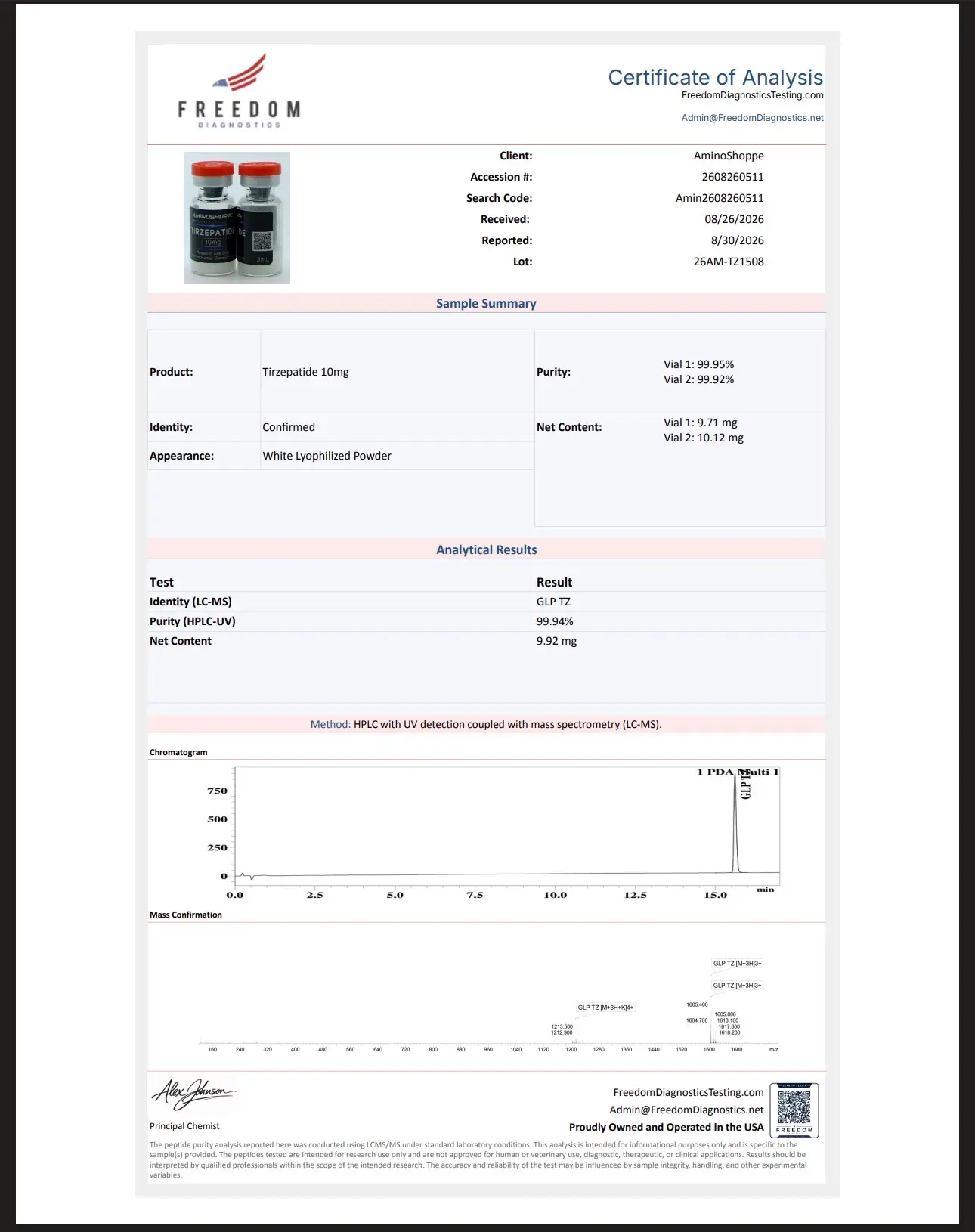
A vial label and a single purity percentage are not sufficient quality records for research materials. When evaluating COA versus chromatogram data, the practical question is not which document looks more technical. It is what each record actually supports, whether the records can be connected to the same lot, and whether the testing method fits the material being purchased.
For research-use-only peptides, mitochondrial compounds, and related laboratory materials, documentation should help a qualified buyer assess lot-specific identity, purity, and handling expectations. It should never be treated as authorization for human or veterinary use. Research materials must be handled only by qualified personnel and used solely for legitimate laboratory research.
COA Versus Chromatogram Data: The Core Difference
A certificate of analysis, commonly called a COA, is a controlled summary of test results for a specific product lot. Depending on the material and laboratory scope, it may identify the analyte, lot number, date of testing, method used, reported purity or assay result, storage guidance, and an approval or review signature. It is designed to provide an efficient quality snapshot.
A chromatogram is the instrument output from a chromatographic analysis, often high-performance liquid chromatography, or HPLC. It displays a signal over time. Peaks represent components detected under the stated method conditions, and the relative area of a target peak may be used to calculate a reported purity value.
The distinction matters. A COA states the laboratory’s reported conclusion. Chromatogram data provides evidence behind one portion of that conclusion, usually purity by a particular chromatographic method. Neither document is automatically complete on its own.
A COA without adequate lot information may be difficult to associate with the vial in hand. A chromatogram without method conditions, sample identification, or integration details may be visually persuasive but analytically limited. Strong documentation allows the buyer to connect product, lot, method, result, and record date without filling gaps through assumption.
What a COA Can Confirm
A properly prepared COA is useful because it organizes the information a research buyer needs to review quickly. The most relevant fields are usually the product name, lot or batch number, test date, reported result, analytical method, and laboratory or reviewer identification.
For a peptide, a COA may report purity by HPLC and identity confirmation by mass spectrometry. For compounds such as NAD+ or other non-peptide materials, the appropriate analytical panel may differ. The method should follow the chemistry of the material rather than a generic documentation format.
A COA can also establish traceability when the lot number on the document matches the lot number on the product label and purchase record. This is a basic but essential control. A high reported purity result has limited value if it cannot be tied to the specific lot received.
Still, a COA is not a substitute for raw data, full method validation documentation, stability studies, sterility testing, endotoxin testing, or a release specification unless those items are expressly listed. Buyers should read the scope of the document rather than infer tests that were not reported.
What Chromatogram Data Can Show
Chromatograms are often requested because they give a closer view of the reported purity result. In a typical reversed-phase HPLC chromatogram, a predominant target peak with limited secondary peaks may support a high area-percent purity calculation under that method.
The visual record is valuable, but interpretation requires context. A clean-looking trace does not independently prove chemical identity. Different compounds can produce peaks under similar conditions, and some impurities may not be detected effectively at the selected wavelength or with the selected separation method. A chromatogram also does not establish biological activity, sterility, or suitability for any use outside controlled research.
When reviewing chromatogram data, check whether the record identifies the sample or lot, the method or instrument conditions, the detection wavelength, retention time, integration table, and reported area percentage. The integration table is particularly important because the graph alone does not show how the purity figure was calculated.
Purity Is Method-Dependent
A result described as “99% purity” is meaningful only alongside the method used to generate it. HPLC area-percent purity is not the same as absolute mass purity, potency, content assay, or identity confirmation. It indicates the proportion of detected chromatographic signal assigned to the main peak under specific conditions.
This is not a defect in chromatography. It is a reason to use the result correctly. For many research purchasing decisions, a lot-specific HPLC purity result is a useful quality indicator. It should simply be read as the measurement it is, not as a blanket claim about every possible characteristic of the material.
How to Review Both Records Before Purchase
The most effective review is a cross-check, not a choice between documents. Start with the COA and determine whether it is sufficiently specific. Confirm that the product name is clear, the lot number is present, the reported test result identifies a method, and the document has a reasonable test date.
Then review any accompanying chromatogram data. The sample identification should align with the COA lot. The reported purity should be consistent with the COA, allowing for the fact that a COA may round values or present results within a specification range. If the documents use different naming conventions, the supplier should be able to clarify how the records correspond.
For higher-sensitivity research applications, ask a more specific question: what risk matters most to the experiment? If identity is the critical variable, mass spectrometry or another identity-appropriate technique may carry greater weight than an HPLC trace alone. If chromatographic purity is the key concern, method conditions and peak integration deserve closer attention. If microbial contamination is relevant to the planned laboratory workflow, a purity chromatogram does not answer that question.
This risk-based approach prevents buyers from requesting documentation that is impressive in appearance but unrelated to their actual control point.
Common Documentation Gaps
Certain gaps should prompt further review before material is accepted into a research workflow. A COA that lacks a lot number cannot reliably support lot traceability. A chromatogram that is not labeled with a sample or lot identifier cannot be confidently assigned to a vial. A purity claim that does not name the method is incomplete.
Other concerns are more subtle. A chromatogram may show a dominant peak while omitting the integration report. A document may identify a compound only by a broad abbreviation, despite multiple salts, ester forms, or sequence variants being commercially available. A test date may be present, but no sample receipt or manufacturing relationship is disclosed. None of these items automatically proves a quality failure, but each limits what the documentation can establish.
Buyers should also avoid comparing purity values across suppliers as if they were identical measurements. Different columns, gradients, mobile phases, wavelengths, and integration settings can affect chromatographic outcomes. A 99% value generated under one method is not necessarily directly comparable to a 99% value generated under another.
Documentation Is Part of Material Control
For a disciplined laboratory purchaser, a COA and chromatogram are part of incoming-material control rather than marketing collateral. Save the records with the purchase information, record the received lot number, inspect label integrity, and maintain storage conditions consistent with the supplier’s instructions. If a lot is divided into internal aliquots, preserve the original traceability record.
At AMINOSHOPPE, research-use-only materials are presented with an emphasis on lot-specific quality documentation and laboratory testing. Documentation should be reviewed before use in any research protocol, particularly where repeatability, method development, or comparative work depends on clear material traceability.
The useful standard is straightforward: accept a COA as a formal reported result, use chromatogram data to understand the analytical support for that result, and request clarification whenever the lot-to-document connection is unclear. Careful record review at receipt is far easier than explaining uncertain material provenance after an experiment is underway.
Related Posts

Reading Peptide HPLC Chromatograms Correctly
A chromatogram can look clean and still leave material questions…

Bacteriostatic Water vs Sterile Water Differences
A vial labeled Water for Injection may look interchangeable at…

Bacteriostatic Water Review for Research Buyers
A bacteriostatic water review should begin with a basic procurement…