A peptide that appears simple on paper can become a variable in the laboratory as soon as it contacts a solvent. This guide to peptide solubility is intended for research personnel evaluating how a lyophilized peptide may behave before preparing analytical or experimental samples. Solubility is not a fixed product attribute. It depends on the peptide sequence, counterion, purity profile, target concentration, solvent system, temperature, and handling conditions.
For research-use-only materials, the correct objective is controlled, documented preparation. A clear solubility assessment helps reduce avoidable sample loss, inconsistent concentrations, precipitation, and uncertainty during downstream work. Materials must be handled only by qualified personnel in appropriate research settings and are not intended for human or animal consumption.
Why Peptide Solubility Varies
Peptides contain side chains with different electrical charges and different affinities for water or organic solvents. The balance of these properties determines whether a material disperses, dissolves, aggregates, or precipitates under a given set of conditions. Two peptides of similar molecular weight can therefore behave very differently in the same solvent.
A sequence with a higher proportion of charged residues may be more compatible with aqueous systems, particularly when the solution pH favors ionization of those residues. A sequence enriched in hydrophobic amino acids may resist aqueous dissolution or form aggregates as concentration increases. Aromatic residues, long hydrophobic stretches, and certain structural features can further increase aggregation risk.
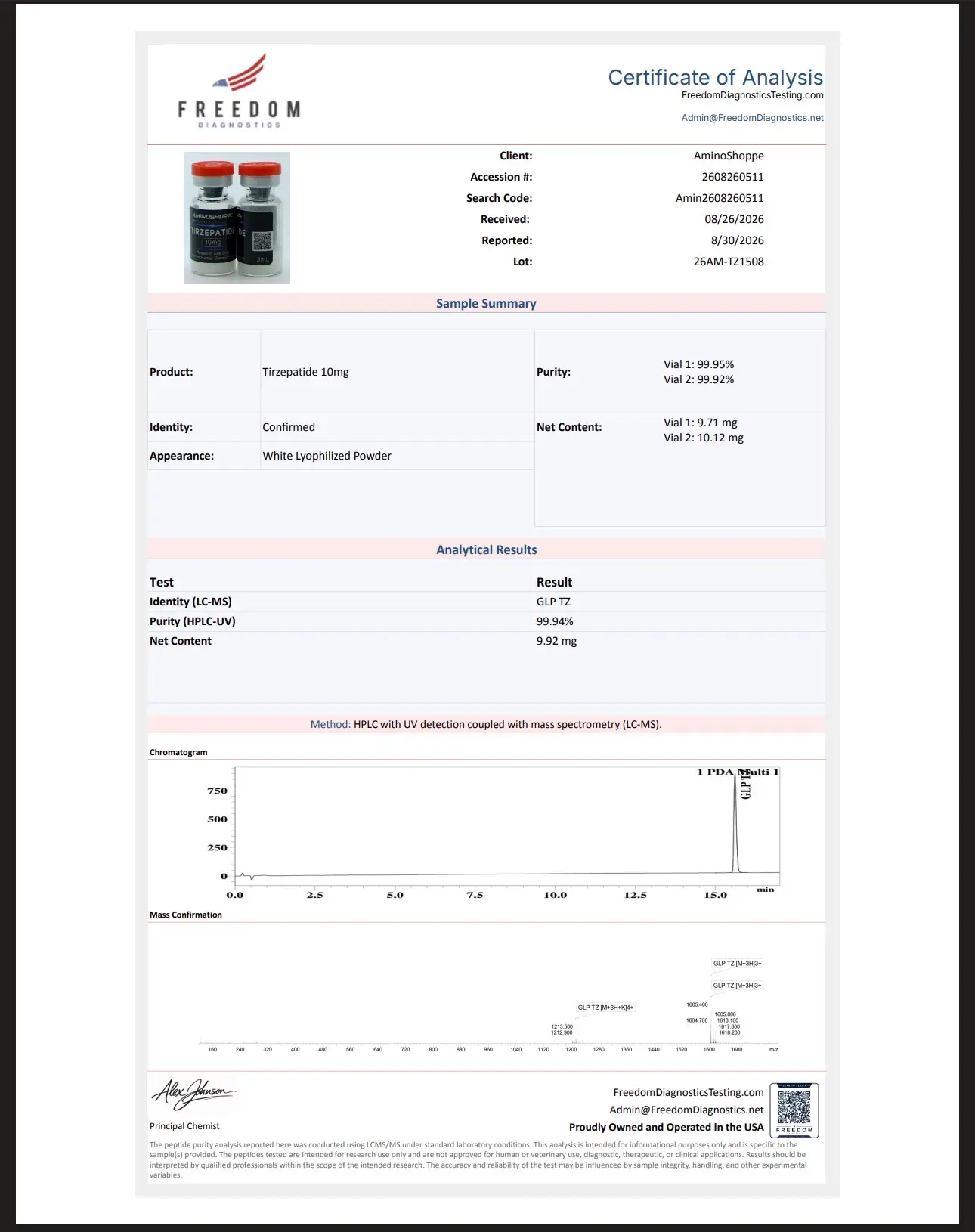
Counterions also matter. A peptide supplied as an acetate, trifluoroacetate, hydrochloride, or other salt form may show different solution behavior from the same sequence in another salt form. The reported mass can include counterion contribution, which may affect molar calculations. Certificate of analysis documentation, sequence information, molecular weight, and salt form should be reviewed before a preparation plan is finalized.
Guide to Peptide Solubility: Start With the Sequence
Sequence review is the most efficient first step. Identify the approximate net charge at the pH range relevant to the experiment, then consider the proportion of hydrophobic residues. This does not replace empirical testing, but it provides a defensible starting point for solvent selection.
Basic residues such as lysine, arginine, and histidine can influence solubility differently depending on pH. Acidic residues, including aspartic acid and glutamic acid, may improve aqueous compatibility when deprotonated. Meanwhile, leucine, isoleucine, valine, phenylalanine, tryptophan, and other hydrophobic residues can make water-only preparations less reliable. Modifications such as lipidation, cyclization, disulfide bonds, terminal blocking, or conjugation can also change behavior substantially.
Use the sequence assessment to form a hypothesis, not a guarantee. A peptide that is theoretically water-soluble may still aggregate because of concentration, ionic strength, temperature, or lot-specific handling history. Conversely, a hydrophobic peptide may perform acceptably at a low working concentration even if a concentrated stock is difficult to prepare.
Concentration Is Often the Deciding Factor
A common error is treating solubility as a yes-or-no question. In practice, a peptide may be fully dissolved at one concentration and visibly precipitated at another. The intended final concentration should therefore be established before selecting a solvent system.
Preparing only the amount needed for the planned experiment can reduce the pressure to create highly concentrated stocks. If a stock solution is necessary, establish whether the peptide remains clear and stable after dilution into the final assay matrix. A clear concentrated stock does not automatically mean the compound will remain in solution after exposure to buffers, salts, proteins, or changes in pH.
Selecting a Solvent System for Research Use
The preferred solvent is the least disruptive system that adequately dissolves the peptide and remains compatible with the downstream method. Purified water or an aqueous buffer may be appropriate for peptides with favorable aqueous behavior. For more challenging materials, a small amount of an appropriate organic co-solvent may be considered during method development, followed by controlled dilution into the experimental matrix.
Solvent choice must account for the full workflow. An organic solvent that improves initial dissolution may interfere with an assay, alter a chromatographic method, affect cell-free reaction conditions, or introduce a concentration-dependent variable. Buffer salts can also promote precipitation when they screen charge interactions or shift pH away from the peptide’s favorable range.
Document the solvent grade, buffer identity, pH, preparation date, nominal peptide concentration, and observed appearance. When reproducibility matters, the order of addition should also be recorded. Small differences in mixing sequence can influence local concentration and aggregation during preparation.
pH and Ionic Strength Require Deliberate Control
pH can alter the charge state of a peptide and meaningfully change its interaction with water. A peptide is commonly less soluble near its isoelectric region, where net charge is reduced and intermolecular association may become more favorable. Moving the pH away from that region can improve solubility, but the acceptable range depends on peptide stability and the needs of the experimental method.
Ionic strength creates a separate consideration. Salts may stabilize some systems while reducing solubility in others. Do not assume that a peptide dissolved in water will behave identically after transfer into phosphate-buffered saline, culture media, or another salt-containing matrix. Confirm behavior at the actual working condition rather than relying only on stock-solution appearance.
Practical Handling Controls
Lyophilized material should be allowed to equilibrate to room temperature while sealed before opening. This helps limit condensation, which can introduce uncontrolled moisture into the vial. Once opened, use clean, dry tools and minimize the time the material is exposed to ambient conditions.
When adding solvent, introduce it carefully against the vial wall where practical and use gentle mixing appropriate for the material. Aggressive agitation can create foam, increase surface exposure, or complicate visual assessment. Some peptides require time to fully hydrate and dissolve. Immediate cloudiness or visible particles should be treated as an observation requiring evaluation, not as a condition to ignore.
If dissolution is incomplete, avoid repeatedly changing multiple variables at once. Adjusting solvent composition, pH, concentration, temperature, and mixing method simultaneously makes it difficult to identify the source of improvement or failure. A small, documented compatibility screen is generally more useful than an improvised preparation.
For materials intended for quantitative work, visual clarity alone is not sufficient confirmation of concentration or identity. Appropriate analytical controls should be selected based on the method. Depending on the research objective, these may include mass-based preparation checks, chromatographic assessment, ultraviolet absorbance where suitable, or other validated laboratory measurements.
Storage After Preparation
A dissolved peptide introduces risks beyond initial solubility. Hydrolysis, oxidation, adsorption to surfaces, freeze-thaw exposure, and gradual aggregation can change the effective concentration over time. The appropriate storage condition depends on sequence, solvent, concentration, and study duration.
Where a method supports it, aliquoting can limit repeated freeze-thaw cycles and reduce unnecessary handling. Use containers appropriate for the solvent system and sample volume, since adsorption losses can be meaningful for low-concentration preparations. Label each aliquot with compound identity, concentration, solvent, date prepared, and storage condition.
A practical stability approach is to evaluate the material over the same period and under the same conditions planned for the experiment. A solution that is stable for a brief analytical run may not be suitable for extended storage. If precipitation, color change, unexpected particulates, or inconsistent analytical response occurs, do not assume the sample remains fit for use.
When a Solubility Issue Needs Investigation
Troubleshooting should begin with records: peptide identity, lot information, salt form, mass weighed, solvent, target concentration, pH, temperature, mixing approach, and storage history. These details often reveal whether the issue is tied to concentration, a buffer transition, an incompatible co-solvent, or sample handling.
Review supporting quality documentation before attributing behavior to the supplied material. A certificate of analysis can help confirm the stated identity and purity profile, but it does not eliminate the need to validate solubility within a specific experimental system. Solubility is a method-dependent property.
A controlled pilot preparation is usually the right next step. Test a limited number of defined conditions, observe the result at the intended working concentration, and retain the method that gives acceptable clarity, consistency, and compatibility with the planned research workflow.
The most useful peptide preparation method is rarely the most complicated one. It is the method that is documented, compatible with the assay, and repeatable by qualified research personnel from one preparation to the next.
Related Posts

Retatrutide vs Tirzepatide Research: Key Differences
Retatrutide vs tirzepatide research is often reduced to a simple…

How to Evaluate Compound Documentation Before Purchase
A certificate of analysis can look credible while providing very…

SS-31 Mitochondrial Peptide Research Overview
A vial label alone is not sufficient documentation for mitochondrial…