A peptide listing can look credible while providing very little evidence that the material was identified, tested, or handled appropriately. Knowing how to verify peptide supplier legitimacy requires more than comparing prices or reading product reviews. Research buyers should evaluate documentation, testing practices, labeling, business transparency, and the supplier’s stated use restrictions before placing an order.
For research-use-only materials, legitimacy is not established by a compound name alone. It is established by whether the supplier can support that name with product-specific records and a consistent quality-control process. A supplier offering compounds such as BPC 157, GHK-Cu, SS-31, MOTS-C, Retatrutide, or Tirzepatide should present its catalog as research materials, not as products intended to diagnose, treat, prevent, or cure disease.
Start With Product-Specific Documentation
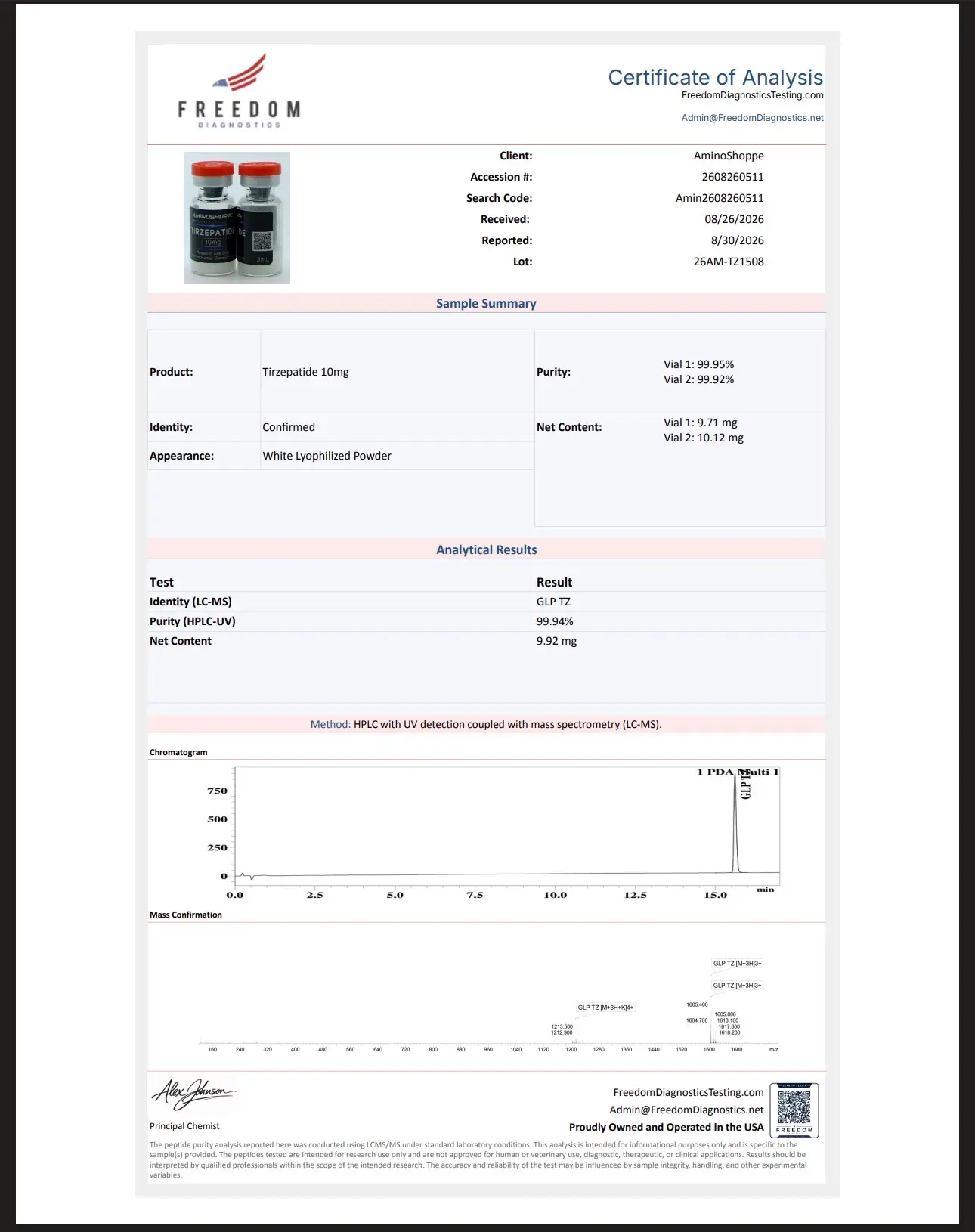
A certificate of analysis, commonly called a COA, is one of the first records to review. A legitimate COA should be connected to a specific lot or batch, not posted as a generic document that could apply to any vial. The lot number on the COA should align with the lot information provided for the product when available. If a supplier cannot explain how its documentation relates to the product being sold, that is a material gap in traceability.
Review what the COA actually reports. At a minimum, a peptide record should identify the analyte or compound, the batch or lot, the test method, the result, and the date of analysis. Purity is often reported as a percentage, but a purity figure without a method has limited value. For many research peptides, high-performance liquid chromatography, or HPLC, is commonly used to assess chromatographic purity. Mass spectrometry may be used to support molecular identity.
A COA is stronger when it provides enough detail for a technically informed buyer to understand the result. That does not always mean every raw instrument file must be publicly available. It does mean the document should not rely on vague language such as “lab verified” without naming the material, method, batch, and result.
How to Verify Peptide Supplier Legitimacy Through Testing
Independent testing is a meaningful trust signal, particularly when the supplier identifies the laboratory or clearly describes the testing arrangement. A supplier’s internal quality claim may be useful, but third-party analysis adds separation between the seller and the reported result. U.S.-based lab testing can also provide clearer accountability for domestic research buyers, provided the records are product-specific and current.
Do not treat a single percentage as the entire quality assessment. Purity, identity, fill weight, residual solvents, moisture, and microbiological considerations can matter differently depending on the compound and the intended research workflow. The appropriate test panel depends on the material. For example, a lyophilized peptide may require different handling and analytical considerations than NAD+ or bacteriostatic water.
Ask whether the supplier can distinguish between identity testing and purity testing. A clean chromatographic profile does not independently prove that the expected molecular structure is present. Likewise, a mass result that supports molecular weight does not provide a complete purity profile. Legitimate quality control recognizes the difference and does not present one test as proof of every quality attribute.
Be cautious with documents that appear altered, contain inconsistent dates, use mismatched product names, or omit the tested quantity. Reused COAs are another concern. A certificate dated years earlier may not represent current inventory, even if the compound name matches. Testing records should make sense within the supplier’s current catalog and inventory practices.
Evaluate the Supplier’s Operating Signals
Legitimacy is also visible in how a supplier operates outside the product page. A credible research-materials business provides clear business contact information, accessible policy pages, defined shipping practices, and a workable customer-support channel. These are basic operational controls, not optional marketing features.
The supplier should also state its use restrictions plainly. Research-use-only peptides should be labeled and marketed for laboratory research only, not for human or animal consumption. Claims about weight loss, performance enhancement, anti-aging outcomes, therapeutic effects, dosing, or administration are incompatible with a compliance-focused research supply model. A seller that promotes those uses while placing a small disclaimer elsewhere is sending conflicting signals.
Age-gated access, buyer qualification language, and visible research-use disclaimers do not prove analytical quality by themselves. They do, however, show whether the supplier understands the regulatory boundaries of its catalog. Strong suppliers pair those controls with accurate product naming, clear storage guidance where applicable, and disciplined product descriptions.
Pricing should be evaluated in context. An unusually low price may reflect volume purchasing or a limited promotion, but it can also indicate weak sourcing, poor documentation, or a product that does not match the stated specification. The lowest cost per milligram is not automatically the best procurement decision when repeatability and recordkeeping matter.
Review the Product Page for Traceability
A legitimate listing should give the buyer enough information to identify what is being purchased. This usually includes the compound name, stated quantity, form or presentation, research-use restriction, and relevant handling details. For materials sold in different vial sizes or concentrations, the listing should clearly distinguish each variant rather than leaving buyers to infer the specification from an image.
Pay attention to naming consistency. The product name, COA, label, and any test documentation should use compatible terminology. Minor differences in formatting can be normal, such as a hyphenated versus non-hyphenated name. A completely different compound name, incorrect molecular description, or unexplained concentration discrepancy is not normal.
Labels should be functional, not decorative. At a minimum, research materials should be identifiable through product name, quantity or concentration when applicable, and an appropriate research-use statement. Lot identification and storage information further improve traceability. A label cannot replace laboratory testing, but poor labeling makes it harder to maintain records after receipt.
Questions a Research Buyer Should Ask
Before ordering from an unfamiliar supplier, request clarification when the available information does not answer the following questions:
- Is there a COA for the specific lot or batch being offered?
- Which analytical methods were used for identity and purity assessment?
- Is testing performed by an independent laboratory, and is that relationship described clearly?
- Does the product labeling match the listing and supporting documentation?
- Are products explicitly restricted to laboratory research use only?
- Can the supplier provide responsive support on batch records, shipping, and product handling?
The quality of the response matters as much as the response itself. A legitimate supplier may not disclose proprietary sourcing details or complete laboratory workflow records. That is reasonable. However, it should be able to answer straightforward questions about the product’s identity, lot documentation, test method, and research-use status without making unsupported claims.
Separate Verification From Assumption
Several common shortcuts are unreliable. Professional website design does not validate a peptide. A large social following does not confirm a batch result. Customer testimonials may describe shipping or packaging but are not analytical evidence. Even a downloadable COA should be assessed for specificity, consistency, and method details.
Verification is a layered process. Product-specific testing establishes a technical foundation. Traceable labeling and batch records connect the documentation to the material. Compliance-forward marketing and transparent operating practices show whether the seller is functioning as a serious research supplier rather than relying on implied credibility.
For repeat procurement, retain the product page details, COA, lot number, order record, and receipt date with your internal research files. This creates a usable chain of documentation if results need to be compared across batches or if a material must be reviewed later. The right supplier is not simply one that has the compound you need. It is one that makes responsible verification possible before the material reaches your research environment.
Related Posts

BPC 157 COA Standards for Research Buyers
A BPC 157 certificate of analysis is not merely a…

SS-31 Mitochondrial Peptide Research Overview
A vial label alone is not sufficient documentation for mitochondrial…