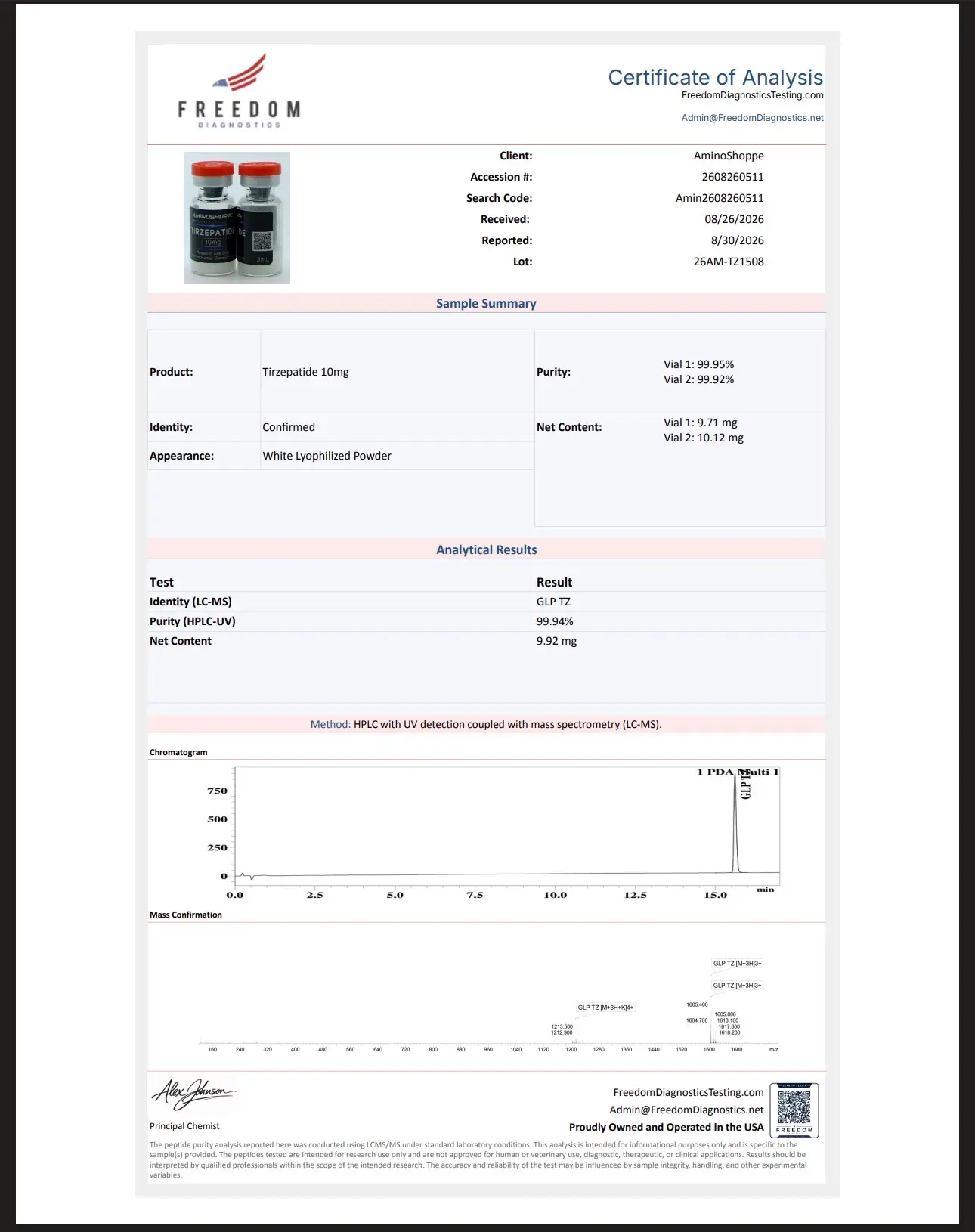
A peptide can arrive with strong analytical documentation and still become unsuitable for research if its storage history is unclear. Knowing how to store research peptides means controlling temperature, moisture, light exposure, handling frequency, and records from receipt through use. Storage requirements should always be based on the product label, certificate of analysis, and supplier-provided handling information. Research materials are for laboratory research only and are not intended for human or animal consumption.
How to Store Research Peptides After Delivery
The storage process begins when the shipment is received. Inspect the outer package, vial integrity, labels, and any cold-chain materials before placing the material into inventory. If a shipment was expected to arrive cold and packaging conditions indicate a possible temperature excursion, document the issue before opening or using the product.
Record the compound name, concentration or fill amount, lot number, receipt date, expiration or retest date, and assigned storage location. This record is not administrative excess. It creates traceability when research results need to be reviewed later. A vial that cannot be matched to its lot documentation or storage history should not be treated as equivalent to a fully documented material.
Do not leave research peptides on a benchtop while other receiving tasks are completed. Move the material to its specified storage condition promptly. For sensitive compounds, even short periods of unnecessary exposure to room temperature, direct light, or humid air can add avoidable variables to a study.
Start With the Product-Specific Storage Direction
There is no single temperature rule that applies to every peptide or bioactive research compound. Lyophilized peptides are commonly more stable than prepared solutions, but stability still depends on the sequence, formulation, vial closure, excipients, fill volume, and intended storage duration. Compounds such as BPC 157, GHK-Cu, MOTS-C, SS-31, Retatrutide, and Tirzepatide should be handled according to the specific documentation supplied for the product in question, not according to assumptions based on a similar compound.
A product label may specify refrigerated storage, frozen storage, or a particular temperature range. Follow that direction exactly where possible. If the supplied documentation does not address a planned storage condition, do not substitute internet guidance for validated handling instructions. Consult the supplier or establish an internal storage decision under the laboratory’s quality procedures.
For long-term inventory, many laboratories use monitored freezer storage when the product documentation supports it. Refrigerated conditions may be appropriate for shorter holding periods or certain prepared materials. The correct choice depends on the product and the duration of storage, not simply on which cold-storage unit is available.
Lyophilized Material and Prepared Solutions Are Different Cases
Dry, lyophilized material generally requires protection from heat and humidity. Keep vials tightly closed and avoid opening them repeatedly. Once a vial is opened, room air can introduce moisture, which may affect material behavior even if no visible change is observed.
After a peptide has been prepared in a suitable laboratory diluent, the storage risk profile changes. Solvent choice, concentration, container compatibility, sterility controls, and freeze-thaw exposure can all affect the material. A prepared solution should be labeled with the compound name, solvent, concentration, preparation date, preparer identification, storage condition, and any established discard or retest date.
Do not assume that storage guidance for dry material applies unchanged after preparation. The available stability window may be shorter, and the preferred temperature may differ.
Control Temperature, Light, and Moisture
Temperature control is only useful when it is consistent. Use a refrigerator or freezer that is suitable for laboratory inventory, monitored with a calibrated or verified device, and not overloaded. Frequent door openings, poor airflow, frost buildup, and crowded shelves can create temperature variation that is not obvious from a single display reading.
Place research peptides in a stable section of the unit rather than in the door or another area subject to frequent warming. Store vials upright when practical, particularly if closures or labels could be affected by contact with condensate. Use a secondary container or organized storage box to prevent breakage, reduce light exposure, and keep lots separated.
Light protection matters for compounds that are light-sensitive or supplied in amber containers. Retain the original vial and carton when possible, since the supplied packaging may provide a defined level of protection. If inventory must be transferred to another container, ensure the replacement offers equivalent physical and light protection and does not obscure the original lot information.
Moisture control is especially relevant for lyophilized products. Avoid repeatedly moving cold vials into humid room conditions and back into storage. Condensation can form on a cold vial, and opening it before the container has equilibrated can introduce moisture. Allow sealed vials to reach the required handling temperature before opening when laboratory procedure calls for it.
Minimize Freeze-Thaw Events
Repeated freeze-thaw cycles can create unnecessary variability for prepared peptide solutions. The extent of risk varies by compound and formulation, but avoiding repeated cycling is a standard control measure when stability data are limited.
If repeated access is anticipated, prepare appropriately sized research aliquots only under controlled laboratory procedures and only when the material’s handling information supports that approach. Smaller working containers may reduce the need to thaw an entire preparation for each experiment. Each aliquot should be fully traceable to the original vial and lot.
Do not repeatedly thaw a solution, remove a portion, and return it to frozen storage without documentation. If the same material produces inconsistent research results later, an undocumented storage history makes root-cause review difficult. Record each transfer, preparation event, and storage change in the applicable inventory or laboratory notebook system.
Use Clear Labels and Controlled Inventory Practices
A freezer is not an inventory system. Labels should remain readable at low temperatures and should identify the material without requiring a researcher to rely on memory. At minimum, maintain the compound name, lot number, concentration or fill amount, storage requirement, receipt date, and expiration or retest information.
For prepared materials, include the solvent or diluent and preparation date. If the vial is an aliquot, identify the parent material and lot. Avoid handwritten shorthand that only one individual understands. Clear identification protects both the material and the integrity of the research record.
Organize inventory by storage condition and separate research-use-only materials from unrelated laboratory supplies. A defined location system, such as freezer, rack, box, and position, reduces unnecessary searching with the door open. It also supports faster response when a temperature alarm, power interruption, or inventory reconciliation event occurs.
Plan for Equipment Failures and Temperature Excursions
Cold storage equipment can fail without warning. Laboratories handling research peptides should have a basic excursion procedure before an incident occurs. That procedure should identify who receives alarms, where materials can be transferred, how temperatures are documented, and who is authorized to assess affected inventory.
When an excursion occurs, do not assume a product is acceptable because it still looks normal. Visual appearance alone does not verify identity, purity, potency, or stability. Quarantine the affected material, preserve available temperature data, and review the product-specific storage requirement and duration of exposure. Depending on the circumstances, the material may require supplier consultation, additional analytical review, or disposal under laboratory policy.
Backup power, remote temperature monitoring, and written transfer plans are worthwhile controls for laboratories holding temperature-sensitive inventory. The level of control should match the value of the materials, the research timeline, and the consequences of losing a documented lot.
Keep Storage Decisions Tied to Documentation
Quality documentation and proper storage work together. A certificate of analysis supports lot-level identity and quality information at release, while controlled handling helps preserve the material’s condition after receipt. Neither replaces the other.
AMINOSHOPPE research materials should remain in their original labeled packaging whenever practical, with associated lot documentation retained in the laboratory’s records. Before starting a study, confirm that the vial label, lot number, storage history, and research protocol align. This is particularly useful when multiple compounds, lots, or prepared solutions are present in the same project.
The most useful storage practice is also the simplest: treat every vial as a controlled research material from the moment it arrives. Prompt placement, stable conditions, limited handling, and complete records give the laboratory a defensible basis for trusting the material it uses next.
Related Posts

What Is Certificate of Analysis COA?
A product listing can say 99% purity, third-party tested, or…

Top Signs of Peptide Quality for Research
A peptide vial can look professionally labeled and still leave…

Reading Peptide HPLC Chromatograms Correctly
A chromatogram can look clean and still leave material questions…