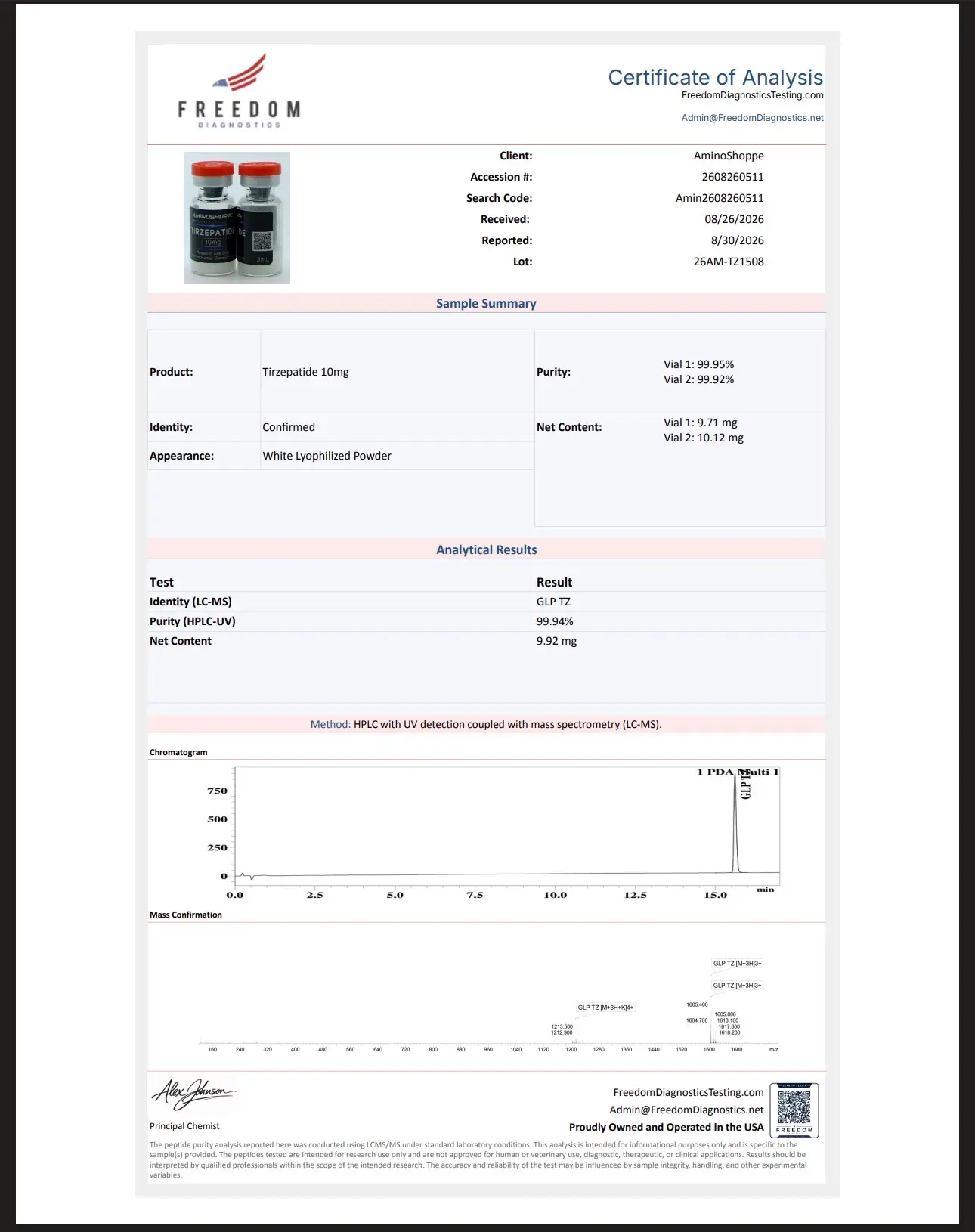
A peptide vial can look professionally labeled and still leave critical questions unanswered. For research buyers, the top signs of peptide quality are not marketing claims, color, or an unusually low price. They are traceable, lot-specific records that support identity, purity, handling expectations, and consistent procurement decisions.
Research-use-only materials should be evaluated within their intended laboratory context. They are not approved for human or animal consumption, diagnosis, treatment, or therapeutic use. A disciplined quality review helps laboratories and independent researchers reduce avoidable uncertainty before a material enters a research workflow.
Top Signs of Peptide Quality Begin With Documentation
The most useful indicator of peptide quality is documentation that can be tied directly to the specific material being purchased. A certificate of analysis, commonly called a COA, should identify the compound, the lot or batch number, the test date, and the reported analytical results. Generic documents that cannot be matched to the vial or listing provide far less value than lot-specific records.
A COA is not merely a formality. It creates a reference point for receiving, inventory control, and later review if a research result raises questions. Before purchasing, confirm that the compound name on the document matches the product name, including relevant salt form, modification, esterification, or sequence notation. Small naming differences can represent materially different research compounds.
The document should also identify the testing laboratory or analytical source. U.S. laboratory testing and clearly presented certificates of analysis give buyers a practical basis for reviewing product claims rather than relying on broad statements such as “high purity” or “pharmaceutical grade.” For research materials, precision in documentation is more useful than promotional language.
Purity Results Need Method Context
Purity is frequently the first number buyers look for, but a percentage without an analytical method has limited meaning. For peptide materials, high-performance liquid chromatography, or HPLC, is commonly used to assess chromatographic purity. The report should indicate the method used and provide a reported purity result that corresponds to the tested lot.
A high HPLC purity result can be a meaningful quality signal, but it does not independently establish every aspect of material identity or suitability for a particular research design. Chromatographic purity reflects separation under stated test conditions. It should be evaluated alongside identity confirmation, lot traceability, packaging condition, and storage history.
Research requirements vary. A screening project may have different specifications than quantitative assay development, stability work, or a method-validation study. Rather than treating one purity threshold as universal, establish acceptance criteria before ordering. Those criteria should reflect the assay’s sensitivity, the planned concentration range, the known behavior of the compound, and the consequences of an inconsistent result.
Identity Confirmation Matters Alongside HPLC
Identity testing addresses a separate question: whether the tested material is consistent with the compound it is represented to be. Mass spectrometry is commonly used for this purpose because it can help confirm molecular mass. Depending on the compound and testing approach, other methods may also be relevant.
Review whether identity data are stated clearly on the COA or supporting lab record. The expected and observed mass values, when provided, should be reasonable for the listed material. Buyers should also verify that the claimed identity corresponds to the exact product format. This is particularly relevant for modified peptides and compounds with nonstandard molecular structures.
Neither a product name nor a purity percentage replaces identity confirmation. The strongest documentation separates these questions: one set of results supports identity, while another supports purity.
Lot Traceability Supports Repeatable Procurement
Lot control is one of the clearest signs that a supplier treats research materials as controlled inventory rather than undifferentiated retail goods. The product container, COA, and product-specific documentation should use matching lot or batch references. This allows a laboratory to record what was received, compare lots over time, and isolate a potential source of variation when needed.
Traceability becomes more valuable as a project extends across multiple orders. If a research team changes lots, that change should be visible in its records. Even when two lots meet the same stated specification, minor analytical variation, handling differences, and project-specific sensitivity may justify a bridging check before combining data sets.
For small laboratories and independent researchers, the process can remain straightforward. Record the supplier, compound name, lot number, received date, COA revision or test date, and storage location. That basic chain of information is often enough to support a more organized investigation if experimental performance later differs from expectation.
Packaging and Handling Are Part of Quality
Analytical results describe the tested material. Packaging and handling help determine whether the material received remains in an acceptable condition for research use. A high-quality peptide should arrive in packaging appropriate to the product’s stated storage requirements, with legible identification and an intact seal or closure.
Inspect the shipment upon receipt. Check for damaged vials, missing labels, compromised caps, moisture intrusion, or a shipping condition that appears inconsistent with the supplier’s stated handling guidance. Document any concern before placing the product into laboratory inventory. Photographs and receipt records are practical quality-control tools, particularly for temperature-sensitive or light-sensitive materials.
Storage instructions should be specific enough to support repeatable handling. Broad directions such as “store properly” are not adequate for controlled research workflows. The supplier should communicate relevant storage conditions, and the buyer should follow them after receipt. Once a product leaves the supplier’s control, improper storage, repeated temperature cycling, inappropriate reconstitution practices, or avoidable exposure to light and moisture can affect material integrity.
Visual appearance can be useful as a receiving check, but it is not a substitute for analysis. Lyophilized material may vary in appearance based on formulation, fill volume, and manufacturing process. A vial’s color or cake structure alone cannot verify peptide identity or purity.
Transparent Supplier Practices Reduce Uncertainty
A supplier’s quality posture is visible in how directly it communicates limitations. Clear research-use-only language, age-gated purchasing controls, accessible lab-test information, and consistent product naming are positive operational signals. They show that the supplier distinguishes laboratory materials from consumer wellness products or unapproved therapeutics.
A credible supplier should not imply that a research compound is intended for ingestion, injection, veterinary administration, or disease-related outcomes. Quality claims should stay connected to what can be documented: analytical testing, lot information, packaging, storage guidance, and order fulfillment practices.
AMINOSHOPPE frames its catalog around laboratory research use, documented testing, and product-specific quality information. For buyers, the useful standard is the same across suppliers: evaluate the evidence available for the exact material and lot, not the strength of the advertising surrounding it.
A Practical Receiving Review for Research Materials
Before introducing a newly received peptide into a study, use a short, repeatable review. First, match the product label to the purchase record and COA. Next, confirm the lot number and review the stated identity and purity results. Then inspect the vial and shipping condition, record the received date, and place the material into the stated storage environment.
If documentation is absent, mismatched, incomplete, or difficult to interpret, pause before using the material. Request clarification that is specific to the product and lot. A supplier response that provides verifiable records is more informative than an assurance that the product is “tested.”
This review does not eliminate all research variability. Peptide performance can also depend on experimental design, solvent selection, concentration, assay matrix, instrument settings, reconstitution procedure, and storage after opening. It does, however, establish a defensible starting point: the material entering the workflow has documentation and handling controls appropriate to the work being performed.
The most effective purchasing decision is usually not based on one impressive number. Select research materials from suppliers that make it possible to verify the lot, understand the test results, follow the handling requirements, and maintain records that support your laboratory’s own quality process.
Related Posts

COA Documentation vs Purity Report Explained
A high reported purity percentage can look decisive on a…

Bacteriostatic Water vs Sterile Water Differences
A vial labeled Water for Injection may look interchangeable at…

Lyophilized Versus Liquid Peptides: Key Differences
A peptide listed as a dry vial and the same…