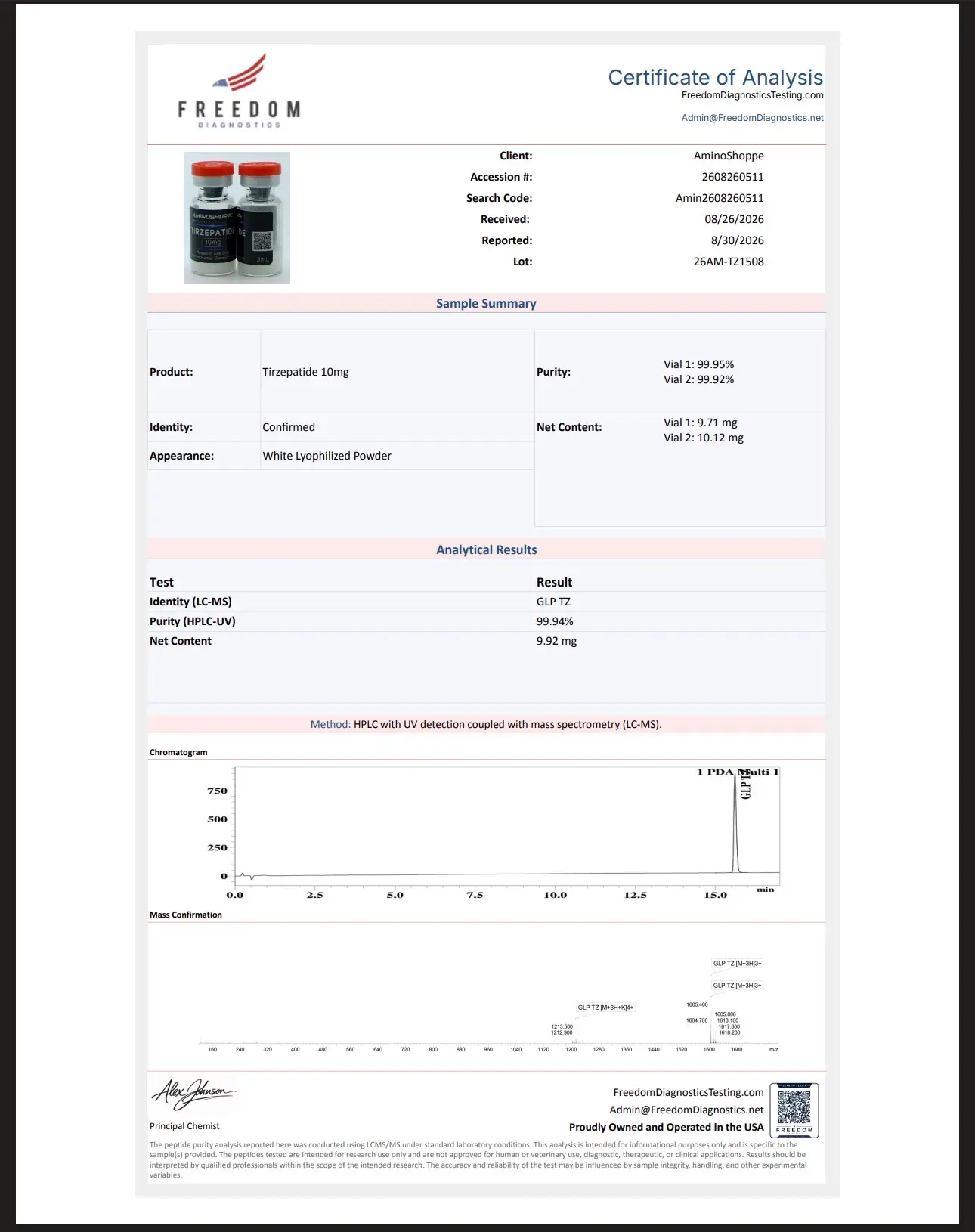
A BPC 157 certificate of analysis is not merely a product attachment. For a research buyer, it is the document that connects a labeled vial to a specific tested lot, analytical method, and reported result. BPC 157 COA standards should therefore be assessed as a documentation and traceability process, not reduced to a single purity percentage.
BPC 157 is supplied for laboratory research only. It is not approved for human or animal use, and a COA does not change that status. The document is most useful when it enables a qualified buyer to verify whether the material aligns with the stated research specification before it enters a study, inventory system, or analytical workflow.
What BPC 157 COA Standards Should Establish
There is no single universal COA template that automatically qualifies every peptide for every research setting. Appropriate documentation depends on the compound format, the intended analytical work, the supplier’s quality system, and the buyer’s internal requirements. Still, a credible BPC 157 COA should answer several basic questions clearly: What material was tested? Which lot was tested? What method was used? What result was obtained? Who issued the report?
The product name should be specific enough to identify the analyte. BPC 157 is commonly associated with the peptide sequence GEPPPGKPADDAGLV. A COA should not rely on a vague label such as “peptide sample” when the product is represented as BPC 157. The stated identity, lot number, and test date should correspond to the material being offered.
Purity is also central, but it requires context. A reported purity value without a stated analytical method gives the buyer less information than it appears to. High-performance liquid chromatography, commonly abbreviated as HPLC, is frequently used to evaluate chromatographic purity. The report should identify the method or at minimum state the relevant test category, allowing the buyer to understand what the percentage represents.
A COA should distinguish analytical findings from marketing language. Terms such as “premium,” “pharmaceutical grade,” or “highest quality” are not substitutes for lot-specific test data. Research purchasers should prioritize measurable information, including the reported purity result, method reference, chromatogram availability where applicable, and lot identification.
Identity Testing Matters Alongside Purity
Purity and identity are related but not interchangeable. A chromatographic purity result may show that one primary peak is present at a stated percentage, but it does not independently establish the molecular identity of that peak. For peptide research materials, mass spectrometry is commonly used as a supporting identity tool.
A well-documented BPC 157 COA may include a mass result that is consistent with the expected molecular mass of the peptide. Depending on the analytical presentation, the report may show a calculated mass, observed mass, charge state information, or a summarized pass result. The level of detail can vary, but the documentation should make clear that identity was evaluated rather than assumed from labeling alone.
For procurement review, the practical question is whether the identity evidence and purity evidence refer to the same lot. A mass-spectrum summary tied to one batch and an HPLC result tied to an unrelated batch does not provide meaningful lot-level assurance. Lot consistency is the point of the record.
Lot Traceability Is a Core Requirement
A COA has limited value if the lot number on the document cannot be matched to the vial, product label, or order record. Buyers should confirm that a unique lot or batch identifier appears consistently across the available documentation. This enables internal recordkeeping and allows a lab to isolate a specific material if questions arise during storage, reanalysis, or experimental review.
The testing date and report date also matter. They show when the analysis was completed and help the buyer determine whether the document is current for the material being sold. Dates alone do not prove stability over time, particularly after shipment, reconstitution, or storage outside recommended conditions. They do, however, establish the timeline of the reported analytical result.
Supplier-controlled identifiers should be legible and internally consistent. A COA that lists a product name but omits a lot number, test date, or issuing laboratory information leaves too many gaps for a procurement-minded buyer. Documentation should support traceability from the supplier’s inventory through the buyer’s receipt and laboratory records.
Reading Purity Results Without Overreaching
Purity is often the first number a buyer checks, and it is a meaningful screening criterion. Yet purity should be read within the boundaries of the method used. HPLC area percentage, for example, is an analytical result under defined test conditions. It should not be interpreted as a guarantee of biological activity, safety, sterility, suitability for administration, or fitness for a particular experiment.
For many research applications, a buyer may establish a minimum purity threshold before approving a material. The appropriate threshold depends on the study design. Exploratory analytical work, method development, and higher-sensitivity research may have different documentation needs. A research team should define its own acceptance criteria before ordering rather than making a decision only after reviewing a COA.
It is also reasonable to examine whether a chromatogram is readable. Peak retention time, peak profile, integration data, and stated conditions can provide more context than a standalone number. A chromatogram does not need to be interpreted as a final scientific conclusion by the buyer, but it should be coherent with the reported purity claim and associated lot.
What a COA Does Not Confirm
A certificate of analysis is a quality-control record, not a blanket approval for every use. It does not establish that a research material is sterile, endotoxin-tested, injectable, clinically evaluated, or appropriate for human or veterinary administration unless those specific tests are clearly performed, reported, and relevant to an authorized use case. Research-use-only materials must remain within their stated handling and use boundaries.
Likewise, a COA should not be treated as a substitute for proper laboratory controls. Receiving inspection, storage documentation, chain-of-custody records, and, when required, independent confirmatory testing remain the responsibility of the research organization. The level of additional verification should reflect the sensitivity and consequence of the intended work.
Buyers should be cautious with certificates that use broad assurances while withholding core details. A document with no analyte identification, no batch reference, no analytical method, or no accountable issuer cannot provide the same level of confidence as a lot-specific report with traceable data.
A Practical Review Process for BPC 157 Documentation
Before purchase or acceptance, a research buyer can review the COA against the product listing and internal specification. Confirm that the product name and lot information match, then evaluate whether the reported identity and purity tests are appropriate for the material. Review the testing laboratory or responsible issuer, test dates, result format, and any stated acceptance criteria.
The process should remain proportionate. Not every project requires the same depth of supplier qualification, but every project benefits from documentation that can be retained and reviewed later. When an experimental result is unexpected, a complete material record helps separate questions about the research from questions about the starting material.
AMINOSHOPPE positions BPC 157 and related materials for laboratory research only, with quality verification and lot documentation serving as key purchasing considerations. Qualified buyers should review available testing records before use and maintain those records with their research files.
A reliable COA is most valuable when it supports a disciplined decision: verify the lot, understand the method, document the result, and use the material only within clearly defined research parameters.
Related Posts

How to Verify Peptide Purity Before Research
A peptide labeled 99% pure may be appropriate for one…

How to Review Peptide Listings Before Purchase
A peptide listing can look complete while still leaving out…

Top Signs of Peptide Quality for Research
A peptide vial can look professionally labeled and still leave…